Short answer: an air-to-water heat pump for a house costs from €3,196 to about €8,600 for the equipment alone, depending on the type and features rather than the floor area. For a house up to 100 m², the entry price is 3 196 €, for 150 m² — 3 783 €, for 200 m² — 3 998 €. Installation is priced separately, after a site visit.
Below are real prices from our in-stock inventory as of August 2026, broken down by floor area, plus an explanation of why the question “how much does a heat pump for 100 square meters cost” is actually the wrong question — and what you should ask instead.
Heat pump price by floor area — table
Sizing starts from the building’s heat loss: 50–60 W/m² with good insulation, built after 2010, 70–90 W/m² with partial insulation, and over 100 W/m² for an old, unrenovated building.
| House area | Required capacity | Equipment price | Models in stock |
|---|---|---|---|
| up to 100 m² | 6–8 kW | from €3,196 to €7,718 | 5 |
| 100–150 m² | 10–12 kW | from €3,783 to €8,614 | 10 |
| 150–200 m² | 14–16 kW | from €3,998 to €8,590 | 9 |
| over 200 m² | 18–30 kW | from €7,669 | 1 |
Prices are for the equipment and do not include installation or hydraulic connections.
Why the price hardly depends on floor area
Take a close look at the table above. Between the smallest and the largest residential unit there’s a difference of about €800, while the capacity doubles. And here’s what happens within the same capacity class:
| Model | Capacity | Price |
|---|---|---|
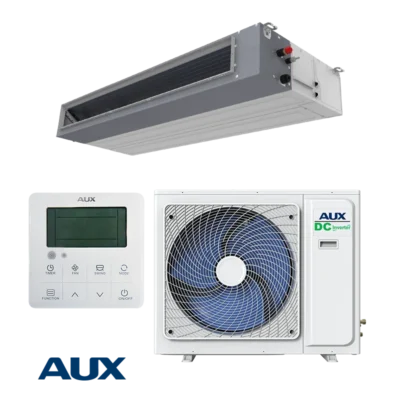
| AUX ACHP-H08/4R3HA | 8,4 kW | 3 196 € |
| AUX ACHP-H16/5R3HA (three-phase) | 16,1 kW | 4 157 € |
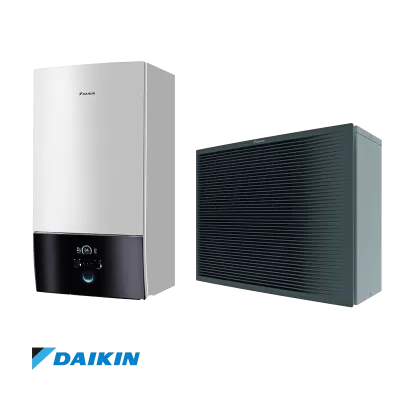
| Daikin Altherma with water tank | 6,0 kW | 7 718 € |
| Daikin Altherma 3 M Monobloc | 12,5 kW | 8 375 € |
A unit with twice the capacity comes out only 30% more expensive. At the same time, a 6 kW heat pump can cost more than a 16 kW one. Two units with the same 12.5 kW differ in price fivefold.
The takeaway is important and saves money: floor area determines what capacity you need, but not how much you’ll pay. The budget is determined by four other things.
1. Monobloc or split
With a monobloc the entire refrigerant circuit is sealed inside the outdoor unit, and only two water pipes enter the house. Installation is faster and nobody touches the refrigerant on site: there is no brazing or vacuuming of pipes. It’s also the cheaper route — mainly for labor: equipment prices for the two types start from similar amounts, so the difference in the total depends on the installation and on where the outdoor unit goes.
A split system has an outdoor and an indoor unit connected by refrigerant piping. The water stays entirely inside the building, which is an advantage if you’re away for long periods in winter, but installation is more complex and more expensive. When each type suits a house and how to protect a monobloc from freezing, we cover in the article monobloc or split heat pump.
2. Temperature range
Low-temperature units supply water at 35–45 °C and work with underfloor heating or fan coils. They deliver the highest seasonal coefficient.
Medium- and high-temperature units reach 60–80 °C and connect to existing radiators without redoing the whole system. This is the main choice when replacing an old gas or oil boiler — and it’s the more expensive class, with a 10–15% lower SCOP.
If the house already has radiators and you’re not planning a major renovation, choose a medium- or high-temperature model. If you’re building new or laying underfloor heating — low-temperature.
3. Domestic hot water and built-in tank
Models with DHW also produce hot water in addition to heating and cooling. Those with a built-in 190-liter water tank add between €2,000 and €3,500 to the price, but eliminate the need for a separate water heater and its installation.
The math here is simple: an ordinary electric water heater works with a coefficient of 1.0, while a heat pump makes the same hot water with a coefficient of 4–5. For a family of four, the difference is felt year-round, not just during the heating season.
4. Power supply: single-phase or three-phase
From about 12 kW up, most units are three-phase. If the property only has a single-phase supply, add the cost of getting three-phase power to your budget — sometimes that’s a bigger item than the price difference between two heat pump models.
Heat pump installation — price and what drives it
The equipment makes up 60% to 80% of the total investment. The rest is split between:
- Hydraulic connections — buffer tank, circulation pumps, expansion vessel, valves, fittings.
- Installation and commissioning — positioning the outdoor unit, pipe runs, insulation, electrical supply and protection, setting the heating curve.
- Adapting the existing system — when switching from a boiler, the operating mode often needs to change or some of the heat emitters need replacing.
- Condensate drainage and freeze protection of the water circuit for a monobloc.
An exact installation price can’t be given over the phone or based on floor area — it depends on the distance to the boiler room, the condition of the existing system, the type of heat emitters and the available power supply. That’s why we offer a free site visit and consultation, after which you receive a fully priced quote for the entire system.
Heat pump — prices for 100, 150 and 200 m²
Heat pump for a 100 m² house
A well-insulated building with underfloor heating. Requires 6–8 kW, low-temperature mode. Entry budget — AUX ACHP-H08/4R3HA with 8.4 kW and SCOP 5,22 for €3,196. It’s also the most efficient unit in the whole range: 5.22 kWh of heat from every kilowatt-hour you pay for.
Heat pump for 150 m² with domestic hot water
Partial insulation, existing radiators, hot water also needed. Requires 10–12 kW plus DHW. KAISAI KHC-12RY3-B — a 12 kW monobloc with heating, cooling and DHW, SCOP 4.6, for €3,783. The smaller version KHC-10RY3-B with 10 kW costs €3,936 — note that the less powerful unit actually costs more here.
Heat pump for 200 m² — three-phase power
An old, unrenovated building with higher heat loss. Requires 14–16 kW. AUX ACHP-H14/5R3HA — 14 kW, SCOP 4.71, €3,998. With DHW: KAISAI KHC-14RY3-B, 14 kW, SCOP 4.6, €4,294. For a bigger margin — KHC-16RY3-B with 16 kW and DHW for €4,806.
Don’t buy „with a margin“
The most common and most expensive mistake is getting a more powerful unit “just in case.” An oversized heat pump runs in short on–off cycles. The result is a lower real-world SCOP than the catalog figure, faster compressor wear and a higher bill — meaning you pay more twice: once at purchase and then every month.
Proper sizing is done after a site visit — based on actual heat loss, not floor area on paper.
What SCOP and the energy class really mean
COP is the coefficient at one specific test point. SCOP is the seasonal coefficient, averaged over the whole heating period with real changes in outdoor temperature. When comparing, look at SCOP — that’s the number you’ll see on your bill.
The energy class is shown separately for heating and for cooling, and the second letter is the one for heating. That’s exactly the one most buyers overlook. A unit rated A+++ for cooling and A+ for heating is the wrong choice for a house that will be heated with it all winter.
Low-temperature operation
All heat pumps in our catalog heat down to −25 °C outdoor temperature, and some series — down to −28 °C. For the climate of Varna, the Black Sea coast and most of the country, that’s a comfortable margin: the operating point almost never gets near the limit, and efficiency stays high all season.
When a heat pump isn’t the right solution
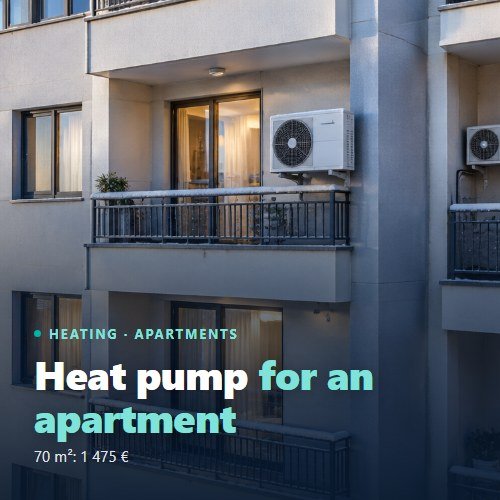
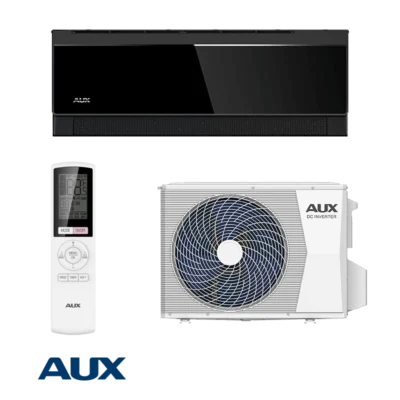
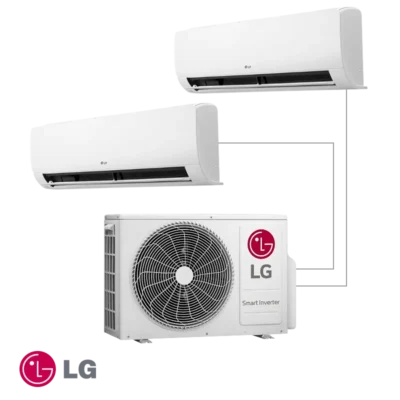
An air-to-water heat pump is a system for a whole building. If you’re heating a single apartment, one or two rooms, or only want to cover the coldest months, an investment of €3,200 and up won’t pay off — the right choice there is an inverter air conditioner from €300, working on exactly the same physical principle with a SCOP of 4.0–5.2.
The logic of the savings is the same in both cases: every direct electric heater — convector, oil-filled radiator, electric stove — has a coefficient of exactly 1.0. Heat pumps and air conditioners are the only electric appliances that exceed it. A detailed comparison with numbers is in the article Cheap electric heating, and choosing an air conditioner for heating is covered in Air conditioners for heating.
Next steps
Browse the full selection in the section air-to-water heat pumps — 81 models from Atlantic, Daikin, KAISAI, Gree and AUX. 77 of them are suitable for residential buildings — with capacities of 4.3–30 kW and prices from €3,196 to €18,253. The remaining 4 are industrial monoblocs of 65–140 kW.
If you’re not sure what capacity you need, don’t guess by floor area. Request a free site visit — we come out, calculate the real heat loss and give you a fully priced quote for the entire system, including installation. The equipment warranty is 36 months.
If it’s still not clear where the savings come from, see how an air-to-water heat pump works — the principle, the system layout and why the temperature class determines whether you can keep your existing radiators.
Heat pump installation in Varna: free site visit
Frequently asked questions
How much does a heat pump for a 100 m² house cost?
Equipment starts at €3,196 for an 8.4 kW unit, which covers a well-insulated house of up to 100 m². Installation and hydraulic connections are priced separately after a site visit.
How much does a heat pump for 150 m² cost?
From €3,783 for a 12 kW monobloc with heating, cooling and DHW. The upper end in this class is about €8,600 for a high-temperature model with a water tank.
How much does a heat pump for 200 m² cost?
From €3,998 for a 14 kW three-phase unit. With built-in domestic hot water — from €4,294.
Why is a more powerful heat pump sometimes cheaper?
Because the price is determined by the type, the temperature range and whether there’s DHW and a tank, not by the kilowatts. That’s why a 16 kW unit can cost less than a 6 kW one with a water tank.
How much does heat pump installation cost?
It depends on the distance to the boiler room, the condition of the existing system, the type of heat emitters and the power supply. An exact price can only be given after an on-site visit, which is free.
Is monobloc or split better?
For a residential building in Varna and along the Black Sea coast, both options work without problems. A monobloc is cheaper to install and has a lower risk of refrigerant leaks; a split keeps the water entirely inside the building.
Does a heat pump work at sub-zero temperatures?
Yes. All models in the catalog heat down to −25 °C, and some series down to −28 °C.
Should I choose a heat pump or an air conditioner?
A heat pump — when you’re heating a whole house or replacing a boiler. An air conditioner — for an apartment or individual rooms. The physical principle is the same; the difference is in coverage and entry price: €300 vs. €3,200.