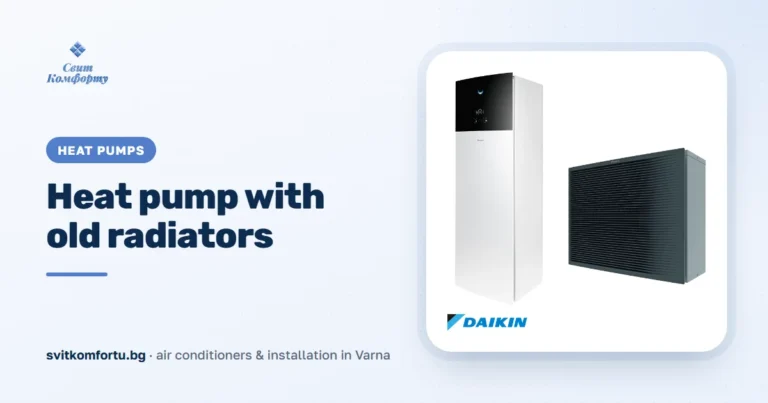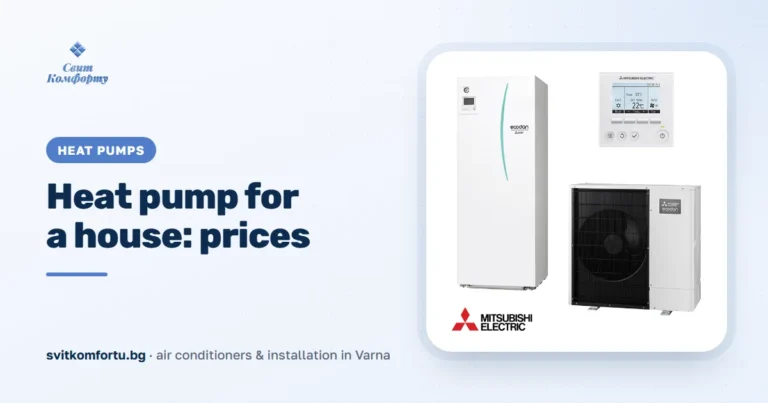
Short answer: a well-insulated 120 m² house in Varna uses about 2,500 kWh of electricity per season when heated with a heat pump and underfloor heating — that is about €371 at €0.15/kWh. The same house with old radiators will pay about €495, and an unrenovated house — about €900. For comparison, with electric convectors the bill is 1 485 €.
Below is the formula to calculate your own case, tables by floor area and insulation level, and the five things that most often ruin the bill in practice.
The Formula: Two Numbers and One Division
The consumption of any heat pump is calculated like this:
Electricity per season (kWh) = Heat required per season (kWh) ÷ SCOP
SCOP is the seasonal coefficient of performance. A SCOP of 4.0 means the unit delivers 4 kWh of heat for every 1 kWh of electricity it uses. In other words, you pay for a quarter of the heat you get — the rest is taken free from the outdoor air.
The heat required is calculated from the building’s heat loss multiplied by the length of the season. For Varna and the Black Sea coast, a good benchmark is 1,500 equivalent full-load hours per season. For Sofia and inland areas the figure is 1,800–2,000, about 25% more.
And heat loss depends on insulation:
- 45–60 W/m² — a house insulated after 2010 or renovated;
- 70–90 W/m² — partial insulation, replaced windows;
- 100–120 W/m² — an old, unrenovated building.
Consumption by Floor Area — Insulated House
Calculated at 55 W/m², 1,500 hours and electricity at €0.15/kWh.
| Area | Required capacity | Heat per season | Electricity at SCOP 4.0 (underfloor) |
Electricity at SCOP 3.0 (radiators) |
|---|---|---|---|---|
| 80 m² | 4,4 kW | 6 600 kWh | 1 650 kWh — 248 € | 2 200 kWh — 330 € |
| 100 m² | 5,5 kW | 8 250 kWh | 2 060 kWh — 309 € | 2 750 kWh — 413 € |
| 120 m² | 6,6 kW | 9 900 kWh | 2 475 kWh — 371 € | 3 300 kWh — 495 € |
| 150 m² | 8,3 kW | 12 400 kWh | 3 100 kWh — 465 € | 4 130 kWh — 620 € |
| 200 m² | 11,0 kW | 16 500 kWh | 4 125 kWh — 619 € | 5 500 kWh — 825 € |
Consumption by Floor Area — Unrenovated House
The same calculation at 100 W/m². Note the difference — same area, same unit, double the bill.
| Area | Required capacity | Heat per season | Electricity at SCOP 4.0 | Electricity at SCOP 3.0 |
|---|---|---|---|---|
| 80 m² | 8,0 kW | 12 000 kWh | 3 000 kWh — 450 € | 4 000 kWh — 600 € |
| 100 m² | 10,0 kW | 15 000 kWh | 3 750 kWh — 563 € | 5 000 kWh — 750 € |
| 120 m² | 12,0 kW | 18 000 kWh | 4 500 kWh — 675 € | 6 000 kWh — 900 € |
| 150 m² | 15,0 kW | 22 500 kWh | 5 625 kWh — 844 € | 7 500 kWh — 1 125 € |
| 200 m² | 20,0 kW | 30 000 kWh | 7 500 kWh — 1 125 € | 10 000 kWh — 1 500 € |
The conclusion is inconvenient but honest: insulation saves more than your choice of unit. Between the best and the weakest heat pump in the same class, the difference is about 15%. Between an insulated and an uninsulated house — 80%.
Heat Pump vs. Everything Else
A 120 m² house with good insulation, requiring 9,900 kWh of heat per season:
| Heating method | Coefficient | Consumed | Cost per season |
|---|---|---|---|
| Heat pump + underfloor | SCOP 4,0 | 2,475 kWh electricity | 371 € |
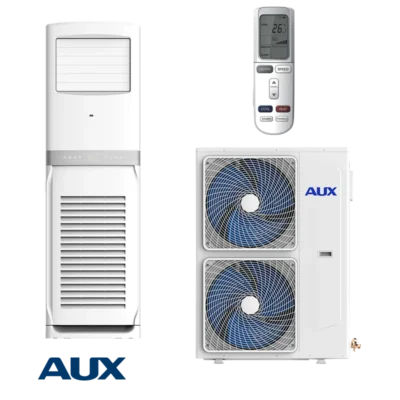
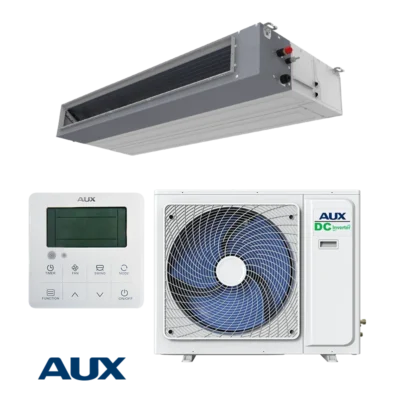
| Air conditioners (split) | SCOP 4,6 | 2,150 kWh electricity | 323 €* |
| Heat pump + radiators at 55 °C | SCOP 3,0 | 3,300 kWh electricity | 495 € |
| Pellets | Efficiency 0.85 | ≈2.4 t of pellets | ≈607 € |
| Convectors, oil heaters, IR panels | 1,0 | 9,900 kWh electricity | 1 485 € |
| Electric boiler | 0,97 | 10,200 kWh electricity | 1 530 € |
* Air conditioners come out cheapest on paper, but they only heat the rooms that have indoor units, do not produce hot water and leave hallways, bathrooms and utility rooms cold. For an apartment that is an advantage; for a house, a limitation. The comparison for homes is in our article on cheap electric heating.
The difference between a heat pump and direct electric heating is about €1,100 per season. With a €3,196 unit, that means a payback of under three seasons — if you are replacing convectors. If you are replacing pellets, the payback is much longer and the decision is more about comfort than money.
Real SCOP Values of the Units in Stock
Don’t take “SCOP up to 5” from the ads at face value. Here are the values from the technical data of the models we keep in stock:
| Model | Capacity | SCOP | Price |
|---|---|---|---|
| AUX ACHP-H08/4R3HA | 8,4 kW | 5,22 | 3 196 € |
| AUX ACHP-H14/5R3HA | 14 kW | 4,71 | 3 998 € |
| AUX ACHP-H16/5R3HA | 16,1 kW | 4,63 | 4 157 € |
| KAISAI KHC-12RY3-B | 12 kW | 4,60 | 3 783 € |
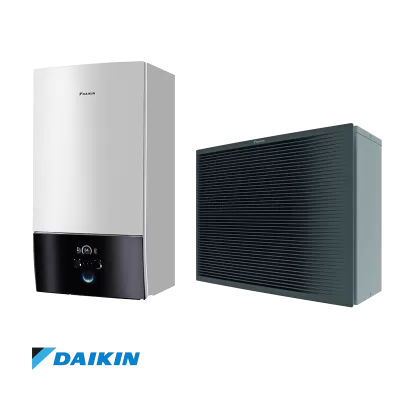
| Daikin Altherma ETBX12E9W | 12 kW | 4,82 | 12 054 € |
Heads up — this is the most frequently overlooked detail: all these SCOP values are measured at 35 °C flow water, that is, with underfloor heating. If you will be supplying 55 °C to radiators, the real seasonal coefficient drops to 2.9–3.3. That is why the tables above have two columns. For a detailed explanation — see our article on heating with a heat pump and radiators.
The Five Things That Ruin the Bill
1. Water That Is Too Hot
The most expensive mistake. Every degree you raise the flow water temperature costs 2–2.5% of efficiency. The difference between 45 and 65 °C is double the bill. If the system keeps the rooms warm at 45 °C, don’t raise it to 55 “just in case”.
2. A Unit That Is Too Large
A heat pump sized “with a big margin” cannot reduce its output enough in a mild winter. It switches on and off every few minutes — short cycling. Every compressor start costs electricity, and the seasonal coefficient drops by 10–20%. That is why capacity is calculated from heat loss, not floor area — see how to calculate the required capacity.
3. Domestic Hot Water at High Temperature
Hot water requires 50–60 °C, at which COP drops to 2.5–3.0. For a family of four, that is about 1,000 kWh of electricity, or €150 per year — on top of heating. Set the water tank to 48 °C and run the anti-legionella program once a week, not every day.
4. Small Water Volume in the System
If the system doesn’t hold enough water, the unit has nowhere to “store” heat and ends up short cycling again. Old cast-iron radiators usually provide enough volume; small panel radiators rarely do. The solution is a buffer tank.
5. Fixed Temperature Instead of a Weather-Compensation Curve
If the heat pump supplies 55 °C whether it is −5 or +12 °C outside, for most of the season it runs far more expensively than it needs to. Weather-compensated control lowers the water temperature when it is mild outside — and that alone brings 10–15% savings. The feature is standard on all models in our catalog; it just needs to be set up at commissioning.
What About an Apartment?
An air-to-water heat pump almost never pays off in an apartment. The investment starts at €3,200, you need space for the outdoor unit, hydraulic connections and approval from the building’s owners’ association, and the heated area is small.
For an apartment, the same physics is achieved with an inverter air conditioner or multi-split system — the same heat pump cycle, only air-to-air, at an entry price of about €450 and a SCOP of up to 5.2. The differences are covered in our articles on multi-split systems and on the best air conditioners for heating. How much electricity an air conditioner uses by BTU size — in our separate air conditioner electricity cost breakdown.
An air-to-water heat pump makes sense when you are heating a whole house, have a water-based heating system and/or are replacing a boiler.
What to Do Now
Take the table, find the row with your floor area and pick the column based on how you will distribute the heat. The number you get is your realistic bill — not the advertised one.
For an exact figure, a site survey is needed: we measure heat loss room by room, check the installation and power supply and give you a fully priced quote for the whole system including installation. Browse the available models in the section air-to-water heat pumps — from €3,196, 36-month warranty, installation in Varna and along the Black Sea coast. Equipment prices by floor area are in our article heat pump for a house — price. The site survey is free.
Frequently Asked Questions
How much electricity does a heat pump use per month?
For a well-insulated 120 m² house in Varna — about 2,475 kWh for the whole season, that is an average of 410 kWh per month over six months of heating, or about €62 a month. In the coldest months, January and February, the bill is double that of November and March.
How much does heating with a heat pump cost per season?
At €0.15/kWh: €248 for 80 m², €371 for 120 m² and €619 for 200 m², if the house is insulated and heated with underfloor heating. With old radiators, add about a third. For an unrenovated house, the bill is roughly double.
Is a heat pump cheaper than electric convectors?
Yes, and the difference is large. A convector has a coefficient of exactly 1.0; a heat pump — 3 to 5. For a 120 m² house that is €1,485 vs. €371 per season, saving over €1,100 a year.
What is a good SCOP for a heat pump?
Above 4.5 at 35 °C water is a very good result for a residential unit. The models in our catalog range from 4.5 to 5.22. Remember that at a 55 °C flow temperature, the real seasonal coefficient drops to about 3.0, whatever the label says.
How much does a heat pump use for hot water?
For a family of four — about 1,000 kWh of electricity a year, or €150. Hot water requires 50–60 °C, at which COP is 2.5–3.0, significantly lower than for space heating.
Does a heat pump work in sub-zero temperatures, and how much does it use then?
It does — all models in our catalog heat down to −25 °C. Efficiency does drop, though: at −7 °C outside, COP is about 2.5–3.0 instead of 4.5. For Varna and the Black Sea coast, this affects only a small part of the season, so the seasonal coefficient stays high.
Does a heat pump pay off in an apartment?
Rarely. The investment starts at €3,200, plus requirements for the location and the owners’ association. For an apartment, the same principle works through an inverter air conditioner or multi-split system at an entry price of about €450.