Short answer: yes, a heat pump works with radiators — always. The question is never “whether,” but at what water temperature. Your old system was designed for 75 °C, while a budget heat pump delivers 55 °C at most. At 55 °C, the same radiator gives off about half of its output. There are three ways out: bigger radiators, fan coil units, or a medium/high-temperature unit. The third option costs about €920 more and doesn’t require touching a single radiator.
Below is the math behind it, a 15-minute test you can use to check your own house before inviting a technician, and real prices for units from our warehouse in Varna.
Why a Radiator Loses Output with Cooler Water
Every radiator has a rated output — for example, 1 500 W. But that number applies only to one specific regime: water at 75/65 °C with the room at 20 °C. That’s how it’s measured under the EN 442 standard, and that’s how every system built for a gas, oil or solid-fuel boiler was sized.
A radiator gives off heat in proportion to the difference between the average water temperature inside it and the room temperature. Lower the water temperature and that difference drops — and output drops with it, faster than linearly:
| Water regime | Difference vs. a 20 °C room | Actual output of the same radiator |
|---|---|---|
| 75/65 °C — design regime | 50 K | 100% |
| 65/55 °C | 40 K | ≈75% |
| 55/45 °C | 30 K | ≈51% |
| 45/35 °C | 20 K | ≈30% |
| 35/30 °C — underfloor heating | 12,5 K | ≈16% |
Read the 55 °C row once more. A 1 500 W radiator turns into a 765 W radiator. The room the boiler used to heat comfortably suddenly falls short — not because the heat pump is weak, but because the radiator has effectively shrunk by half.
That’s exactly what’s behind most of the disappointed reviews online: the unit is good, the installation is correct, but nobody recalculated the heat emitters.
What High Temperature Costs on Your Bill
The flip side: the hotter the water you demand from the heat pump, the less heat it gives you for the same electricity. Its efficiency (COP) drops by about 2–2.5% for every degree of flow temperature increase.
| Flow temperature | Approximate COP at 7 °C outdoors | Bill vs. underfloor |
|---|---|---|
| 35 °C (underfloor) | 4,6–5,2 | 100% |
| 45 °C (fan coils) | 3,6–4,0 | +25% |
| 55 °C (upsized radiators) | 2,9–3,3 | +55% |
| 65 °C (old radiators) | 2,2–2,6 | +100% |
That’s why “I’ll just turn up the temperature and be done” is the most expensive solution: at 65 °C you pay roughly double compared with the same house with underfloor heating. The detailed calculation in BGN and euros is in our separate article on heat pump electricity consumption for heating.
Important about labels: when you see SCOP 4.6 or COP 5.2 in a catalog, that number is almost always measured at 35 °C water. If you’ll be supplying 55 °C, divide your real bill not by 5 but by 3.
Three Scenarios That Work
Scenario 1. Underfloor heating or a new system — 35–45 °C
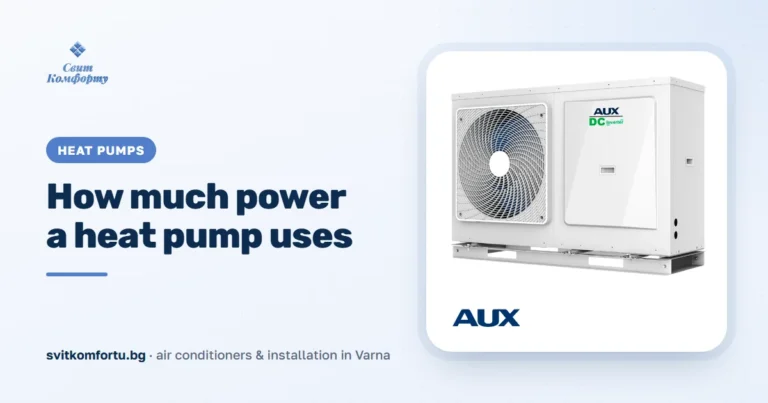
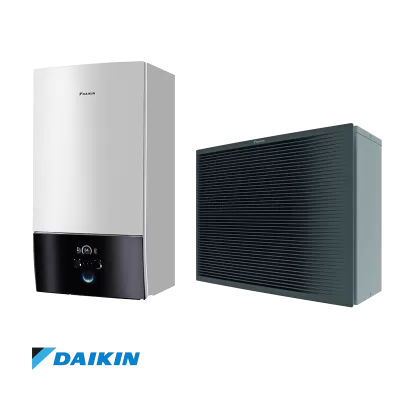
The cheapest regime to run and the cheapest unit to buy. A low-temperature heat pump is all you need. This covers almost every model in our catalog — AUX, Gree Versati, KAISAI, Atlantic LORIA and EXTENSA, and Daikin Altherma in the low-temperature version.
The entry price is AUX ACHP-H08/4R3HA — 8,4 kW, SCOP 5,22, 3 196 €.
Scenario 2. Existing radiators in a well-insulated house — 55 °C
This works more often than expected, and the reason is hidden: old systems are almost always oversized. Radiators were installed “with a margin,” and later the house got new windows, insulation and a new roof. Its heat losses today are half the design figure, while the radiators are the same.
If your radiators deliver at least double the room’s actual heat loss, 55 °C is enough. Below is a test that lets you check this without any calculations.
In this scenario, sometimes you only need to replace two or three heat emitters — usually in the coldest north-facing room and the bathroom — rather than the whole system.
Scenario 3. An unrenovated house with old radiators — 65 °C
When the house isn’t insulated and you’re not planning a renovation, the only honest option is a medium- or high-temperature heat pump that supplies up to 65 °C and connects to the system as it is.
| Model in stock | Capacity | Class | Price |
|---|---|---|---|
| Atlantic ALFEA EXTENSA A.I. R32 10 kW | 10 kW | low-temperature | 5 875 € |
| Atlantic ALFEA EXCELLIA A.I. 11 kW | 11 kW | up to 65 °C | 6 795 € |
| Atlantic ALFEA EXCELLIA A.I. 14 kW | 14 kW | up to 65 °C | 7 306 € |
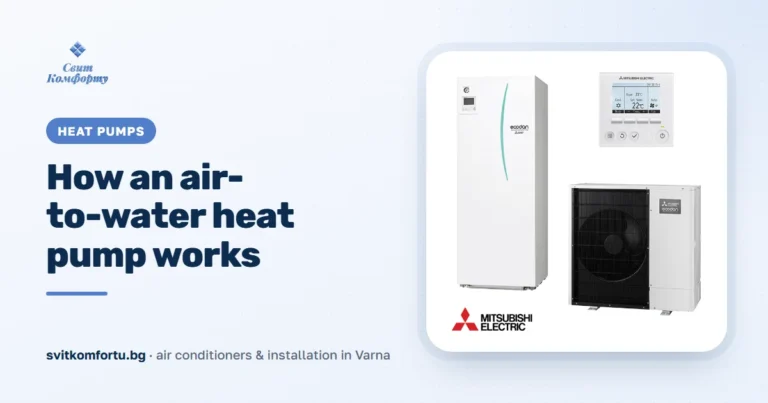
| Daikin Altherma medium-temperature ETBX12E9W | 12 kW | up to 65 °C | 12 054 € |
The difference between EXTENSA 10 kW and EXCELLIA 11 kW is 920 €. That’s the entire cost of the “don’t touch a single radiator” solution. For comparison, replacing eight radiators with bigger ones, labor included, rarely comes in under €1 500, and converting an occupied house to underfloor heating is a renovation, not an installation.
That’s why, in 9 out of 10 cases with an old system, the more expensive unit is the cheaper solution.
The 15-Minute Test: Check Your House Yourself
Before any quotes, do this on the first cold day (around 0 °C outside):
- Lower the boiler’s flow temperature to 55 °C.
- Open all radiator valves fully.
- Leave it like that for 4–6 hours — the house has thermal inertia; the first 30 minutes mean nothing.
- Measure the temperature in the coldest room.
If the rooms hold 21–22 °C — a low-temperature heat pump will cope with your existing radiators. Scenario 2.
If the temperature drops below 20 °C — you need bigger heat emitters or a unit rated up to 65 °C. Scenario 3.
This test costs nothing and saves you from the most expensive mistake when switching to a heat pump. If your house is heated with electricity or solid fuel and you can’t do the test, we measure heat losses room by room during the site visit.
Fan Coil Units — The Third Way
Between “old radiators” and “underfloor heating” there’s an option that’s underrated in Bulgaria: the fan coil unit . It’s a water heat exchanger with a fan — the forced air movement lets it deliver full output with water at just 45 °C.
Advantages over radiators:
- a lower temperature regime → COP around 3.8 instead of 3.0, meaning a bill about 20% lower;
- takes up far less wall space than a radiator of the same output;
- cools in summer — the same heat pump runs in reverse mode, which no radiator can do;
- heats the room in minutes, not an hour.
Drawbacks: it has a fan, so it makes some noise; it requires condensate drainage in summer; and it’s not cheap per unit.
In practice, the most sensible combination in an insulated house with a heat pump is mixed: fan coils in the living room and bedrooms, where you want a quick effect and summer cooling, and the existing radiators kept in the hallway and utility rooms.
Four Mistakes That Ruin the Project
1. Sizing by floor area. “120 m² → 12 kW” is a recipe for an oversized unit that short-cycles — switching on and off every few minutes, wasting electricity and wearing out the compressor. Capacity is calculated from heat losses. For a reference, see also how many BTU you need.
2. Leaving thermostatic valves in their old positions. With a heat pump, the system should run with the emitters fully open and a low water temperature, with regulation done by the unit. Half-closed valves force it to raise the temperature — and your bill.
3. No buffer tank or too little water volume. If the system doesn’t hold enough water, the heat pump can’t run smoothly. In old systems with large cast-iron radiators the volume is usually enough; with small panel radiators, often it isn’t.
4. Old, clogged pipework. A heat pump supplies cooler water, so it needs a higher flow rate. Pipes full of scale and sludge that got by at 75 °C are no longer enough at 50 °C. The system is flushed before installation.
What to Do Now
If your house has radiators, here’s the order: do the 15-minute test → write down the result → request a site visit. During the visit, we calculate heat losses room by room, check whether your existing radiators are enough at 55 °C and tell you honestly which of the three scenarios is yours — including when the answer is “not worth it for now.”
Browse the available models in our air-to-water heat pumps section — Atlantic, Daikin, KAISAI, Gree and AUX, from €3 196, with a 36-month warranty. Installation in Varna and along the Black Sea coast. The site visit is free.
Frequently Asked Questions
Does a heat pump work with old radiators?
Yes. Any heat pump can supply a radiator system. The difference is in the water temperature: low-temperature models deliver up to 55 °C, medium- and high-temperature models up to 65 °C and connect to an old system without modifications. At 55 °C, the same radiator gives off about 51% of its rated output, so you need to check whether your existing emitters are enough.
What water temperature does a heat pump deliver?
Standard low-temperature models operate in the 35–55 °C range. Medium- and high-temperature models (for example, Atlantic ALFEA EXCELLIA or Daikin Altherma in the medium-temperature version) reach 65 °C. The higher the temperature, the lower the COP and the higher the bill.
Do I need to replace my radiators?
Not necessarily. Old systems are usually oversized, and the house has since been insulated and fitted with new windows. Do the 55 °C test: if the rooms hold 21 °C on a cold day, the radiators are enough. Often only one or two emitters in the coldest rooms are replaced.
Which is better — radiators, fan coil units or underfloor heating?
Underfloor is the most economical (35 °C water) but requires renovation. Fan coil units run at 45 °C, take up little space and cool in summer. Radiators are the cheapest because you already have them, but they need the hottest water. In an insulated house, a mixed setup usually wins.
How much more does a high-temperature heat pump cost?
At equal capacity, the difference is about €920 — the ALFEA EXTENSA 10 kW costs €5 875, while the ALFEA EXCELLIA 11 kW with a mode up to 65 °C costs €6 795. That’s less than replacing the radiators in an entire house.
Can a heat pump run underfloor heating and radiators at the same time?
Yes, but only through two separate circuits with a mixing group, because the two regimes need different temperatures — 35 °C for underfloor and 50–55 °C for radiators. If they’re connected on one circuit, the whole system runs at the hotter temperature and the savings from underfloor heating disappear.
What happens to the radiators in summer?
Nothing — radiators can’t cool, because moisture would condense on them. If you also want cooling from the same unit, you need fan coil units or separate air conditioners.