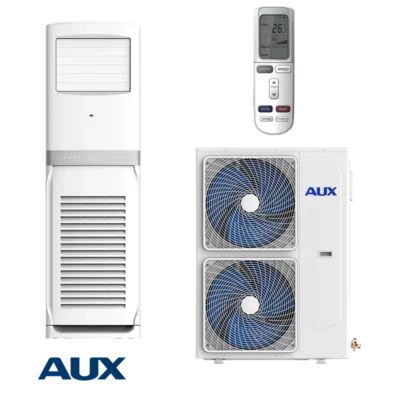
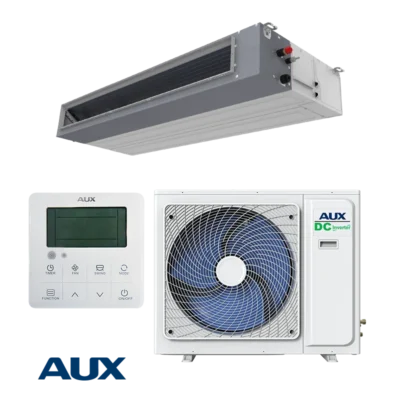
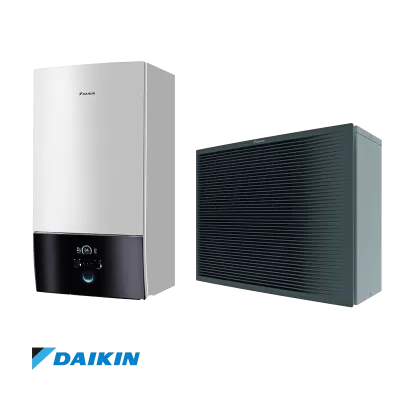
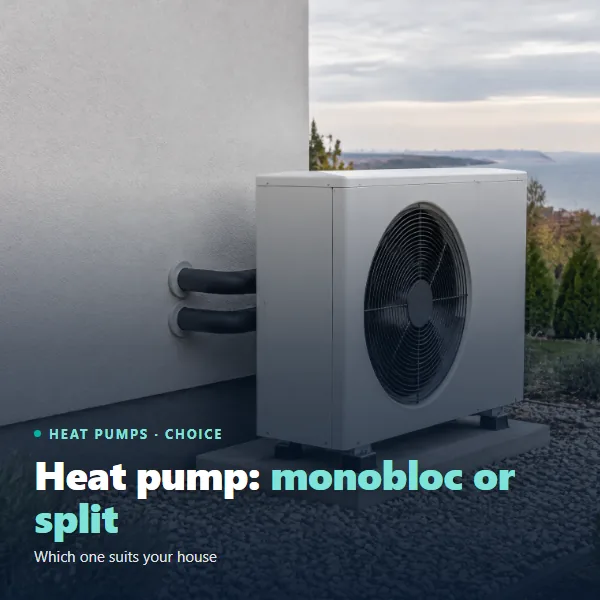
Short answer: in a monobloc the whole refrigerant circuit sits in the outdoor unit and only water enters the house. In a split the refrigerant circuit is connected on site between an outdoor and an indoor unit, and the water stays inside. A monobloc is simpler to install. A split is safer in frost and with a long run to the boiler room. In our catalogue monoblocs start from 3 247 €, and we price the installation after a free site visit.
The question „monobloc or split heat pump“ usually comes from house owners who are replacing an old boiler or building new and have already decided on an air-to-water heat pump. What is left is the type, and it depends more on the house than on the brand.
The difference: where refrigerant and water meet
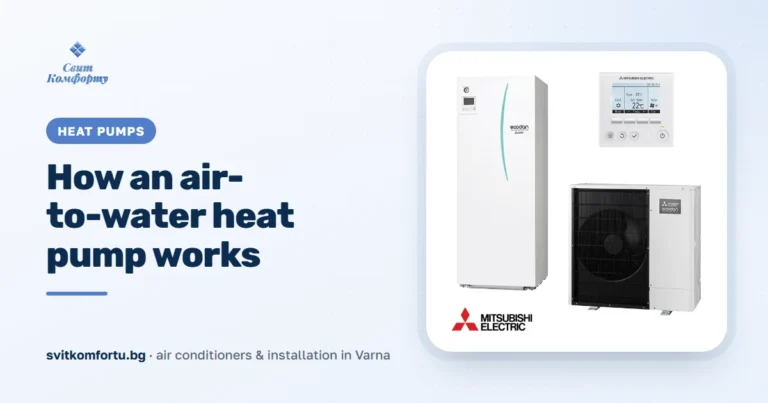
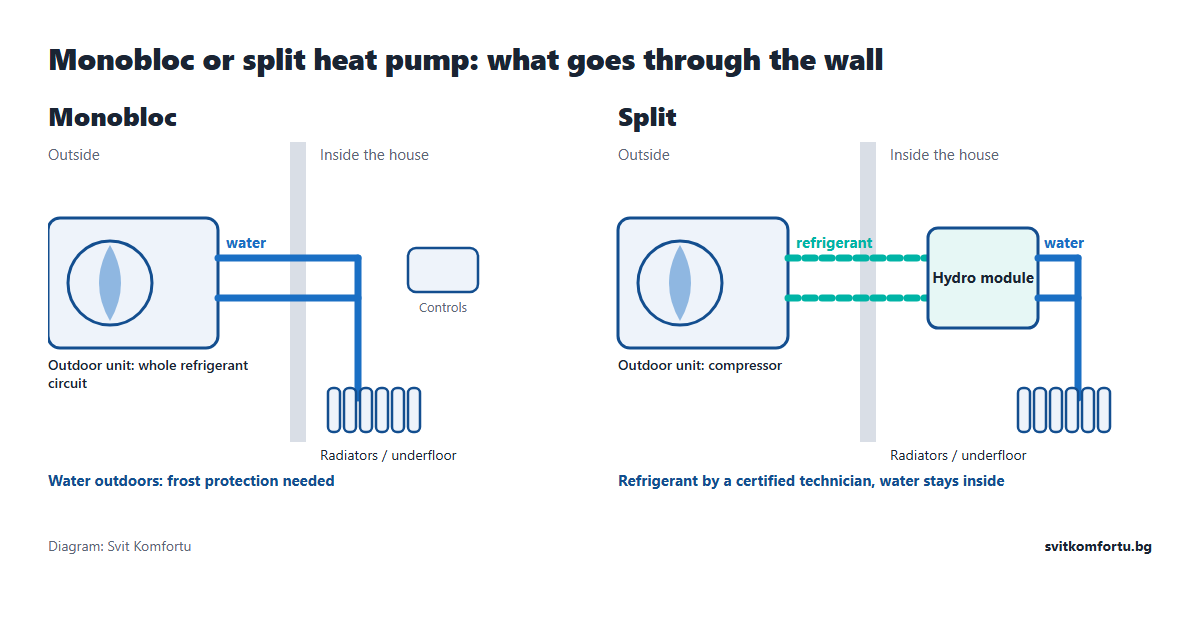
Every air-to-water heat pump has a refrigerant circuit (compressor, heat exchangers, refrigerant) and a water circuit that carries heat to the radiators, the underfloor heating or the hot water tank. The two types differ in where these circuits meet.
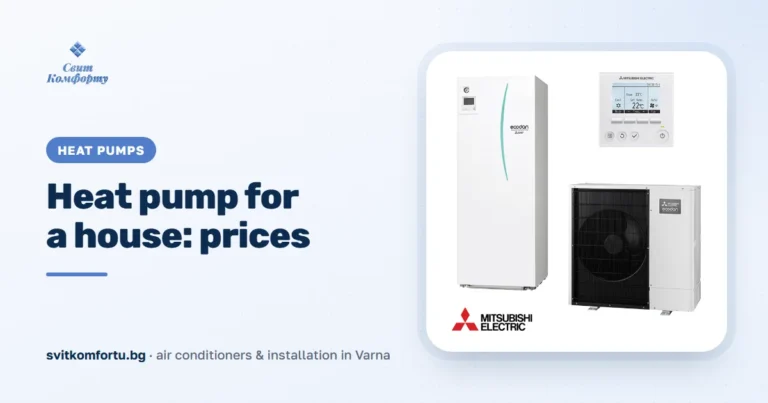
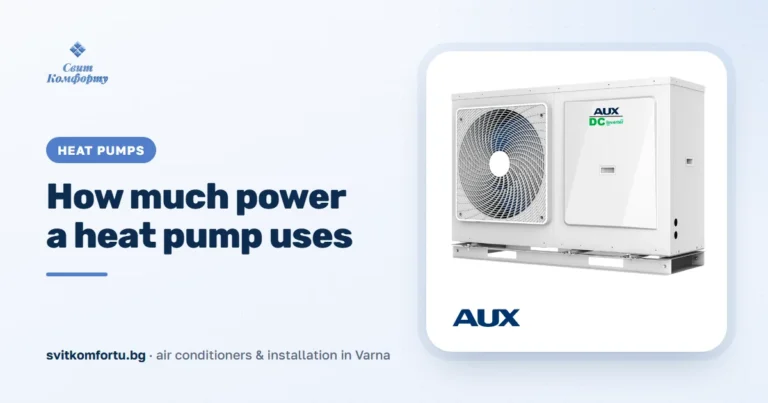
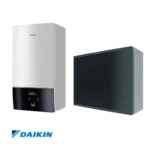
In a monobloc the refrigerant circuit is factory-sealed inside the outdoor unit. The heat exchanger to the water is there too, so two water pipes run from the machine into the house. Nobody touches the refrigerant on site: no brazing, no vacuuming, no charging.
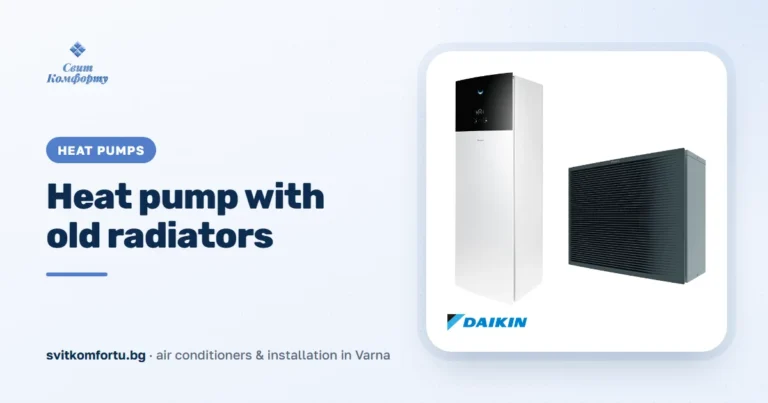
In a split the compressor is in the outdoor unit and a hydro module with heat exchanger, pump and controls stands inside. The two units are joined by copper refrigerant lines, which an F-gas certified technician vacuums and leak-tests. The water never goes outside.
We describe the cycle itself in the article how an air-to-water heat pump works.
Monobloc and split side by side
| Monobloc | Split | |
|---|---|---|
| What enters the house | Two water pipes | Two refrigerant lines and a cable |
| Refrigerant work on site | None | Yes, by a certified technician |
| Water outdoors | Yes, in the unit and the pipes to the wall | No |
| Space indoors | Little: controls and an optional tank | Wall-hung hydro module or a column with a tank |
| Distance to the boiler room | Short is better | Longer, within the limits in the model’s manual |
| Frost protection | Needed: glycol or anti-freeze valves | Not needed for the water |
| Example from the catalogue | Gree Versati IV 6 kW – 3 247 € | AUX ACHP-H08/4R3HA – 3 196 € |
Equipment prices for the two types start from similar amounts. The monobloc Gree Versati IV 6 kW and the split AUX ACHP-H08/4R3HA are among the most affordable in the catalogue. The total for the house depends on the installation, and we work that out on the site visit.
When a monobloc is the better fit
A monobloc is the natural choice when the outdoor unit can stand against the wall behind which the boiler room or bathroom is. Then the outdoor water pipes are a few tens of centimetres long, losses are small and installation goes quickly.
It also suits houses with no room indoors for a hydro module, such as a small boiler room. A monobloc can also run on R290 (propane). It is flammable, so manufacturers keep it in a factory-sealed circuit outdoors. In the catalogue one example is the AUX ACHP-H10/4R2HA-M with R290, 3 600 €.
When a split is the better fit
You choose a split when the outdoor unit has to stand far from the boiler room, in the yard or on the other side of the house. A long run is no problem for it, as long as it stays within the limits in the model’s manual. With a monobloc the same distance means long water pipes in the open.
The second case is a seaside villa left empty in winter, and there are many of these along the Black Sea coast. If the power goes off for days and the monobloc holds plain water, the outdoor pipes can freeze. With a split the water is inside the house and this risk disappears.
A split is also the choice when you want everything in one column: hydro module and hot water tank. Examples are the Atlantic LORIA DUO with a built-in 190 l tank, which in the catalogue start from 5 368 €.
Freezing: the risk with a monobloc
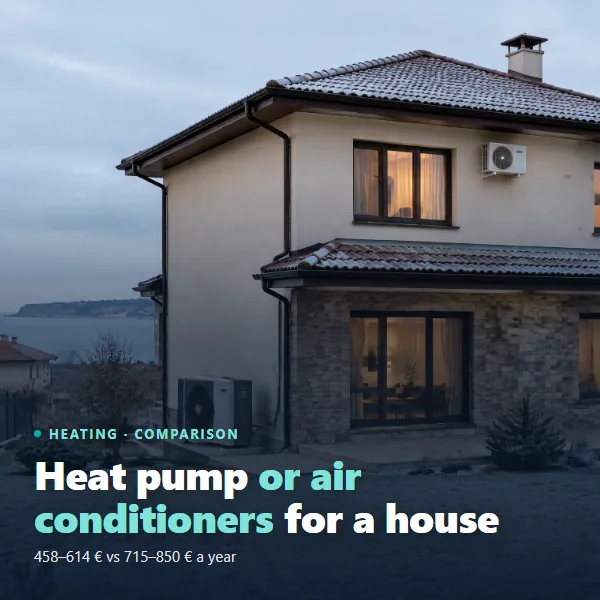
Winters in Varna are mild and the temperature rarely drops below −7 °C, and while the machine runs, its controls keep the water from freezing. The risk comes with a power cut in frost. There are two ways to protect it.
The first is glycol in the water circuit: it does not freeze, but it transfers heat a little worse and puts more load on the pump. The second is anti-freeze valves: when the water in the pipes approaches zero, they drain it outside. We decide which option suits you on the site visit, together with the position of the outdoor unit.
How much space the indoor unit takes
With a monobloc, indoors you have the controls and, if needed, a separate tank. With a split the wall-hung hydro module is the size of a small cabinet: 790 × 420 × 270 mm for the AUX ACHP-H08/4R3HA, 840 × 440 × 390 mm for the Daikin Altherma EHBX08E6V.
Columns with a built-in tank are the size of a fridge. The Daikin Altherma with an integrated tank is 1650 × 595 × 625 mm, the Gree Versati III with an integrated tank 1756 × 600 × 600 mm. We usually put them in the boiler room.
Radiators, underfloor heating and fan coils
Both types work with any heat emitters. What decides is the water temperature: old radiators want hotter water, underfloor heating cooler. We cover both cases in the articles on heat pumps with radiators and underfloor heating with a heat pump.
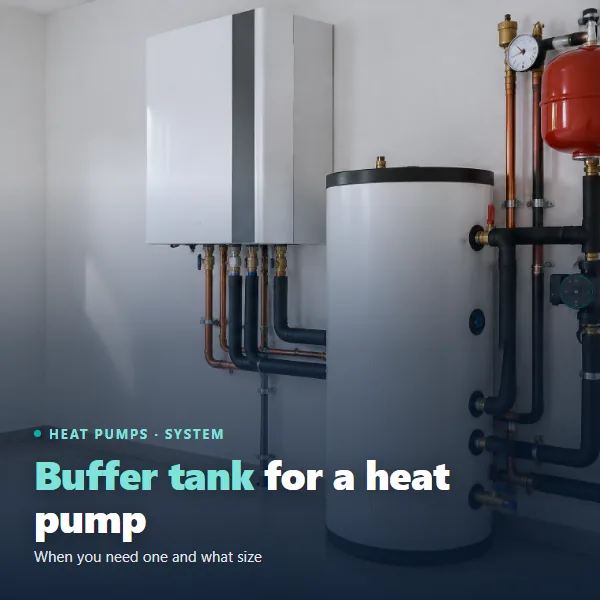
If the radiators are not enough, fan coil units can go into the rooms, and some layouts also need a buffer tank. We can supply and install both together with the heat pump. We price them after a site visit, because the cost depends on the number of rooms and on the installation.
How to decide before the site visit
- Look at where the outdoor unit can stand and how many metres it is from there to the boiler room.
- Think about whether the house stands empty in winter.
- Check whether there is room indoors for a hydro module or a column with a tank.
- Check the power supply: from about 12 kW up, most machines are three-phase.
- Write down what heating you have: radiators, underfloor or mixed.
We size the capacity by the heat losses of the house. Indicative prices by floor area are in the article heat pump for a house: price, and the full range is in the air-to-water heat pumps section.
Free site visit in Varna and the region
On the visit we look at the spot for the outdoor unit, the route to the boiler room, the power supply and the heat emitters. Then we offer you a monobloc or a split with a specific model from stock and a price for the installation. The steps of the work are on the page heat pump installation in Varna. Or call +359 886 392 424.
Frequently asked questions
Which heat pump is better: monobloc or split?
It depends on the house. A monobloc is simpler to install and fits when the outdoor unit is next to the boiler room. A split is more convenient over a long distance and in houses that stand empty in winter.
How much does a monobloc heat pump cost?
In the catalogue air-to-water monoblocs start from 3 247 € for the equipment. Installation depends on the house and we price it after a free site visit.
Can a monobloc freeze?
Not while it runs. The risk is a long power cut in frost. That is why at installation we put glycol in the water circuit or fit anti-freeze valves, depending on where the outdoor unit stands.
Does a split heat pump need a special technician?
Yes. An F-gas certified technician connects the refrigerant lines, vacuums them and checks them for leaks.
Is there a difference in electricity use?
The type alone does not decide it. Compare the SCOP of specific models and the water temperature you need. Seasonal bills are in the article heat pump running costs.