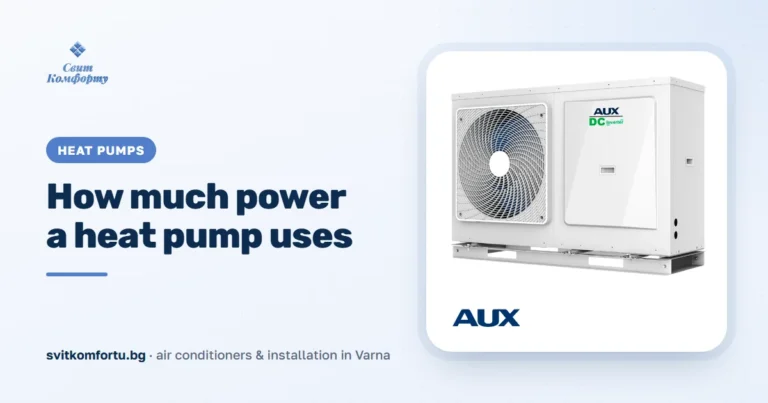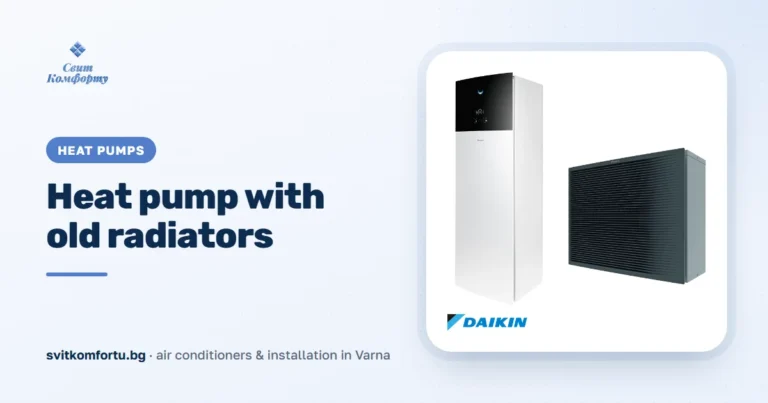
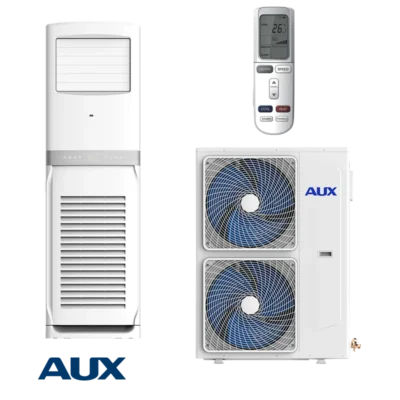
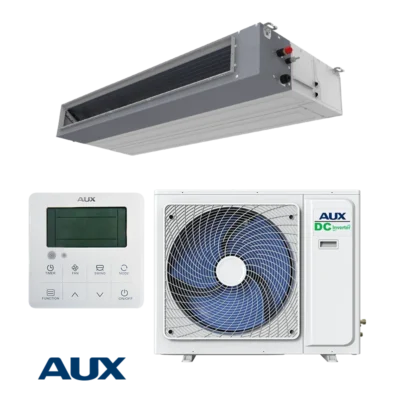
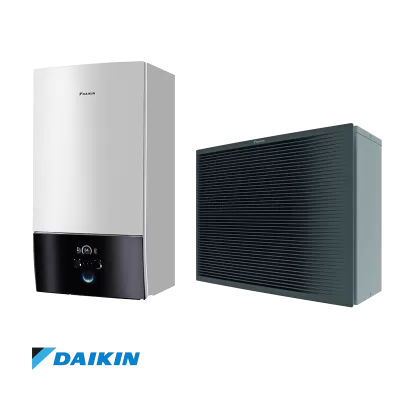
Short answer: an air-to-water heat pump does not generate heat — it moves it — it takes heat from the outdoor air and transfers it to the water in your heating system. That is why 1 kWh of electricity gives you 4 to 5 kWh of heat, while any direct electric appliance gives exactly 1 kWh. The most efficient model in our range has SCOP 5,22.
Below you will find how it works without unnecessary physics, the system layout and — most importantly when choosing — why the temperature class of the unit determines whether you can keep your existing radiators or will have to replace them. In our catalog, this difference is worth over 8 500 €, yet hardly any article explains it.
How an Air-to-Water Heat Pump Works: The Principle
Every direct electric appliance — a convector, an oil-filled radiator, an electric stove, a water heater — turns 1 kWh of electricity into exactly 1 kWh of heat. Its coefficient is 1,0 and physically cannot be any higher.
A heat pump works differently. It uses electricity not to create heat, but to drive a compressor that moves it from outside to inside. Even at −10 °C, the air contains thermal energy — absolute zero is at −273 °C.
The cycle has four steps and repeats continuously:
- Evaporator (the outdoor unit). The refrigerant is colder than the outdoor air, so it absorbs heat from it and evaporates.
- Compressor. It compresses the vapor, which sharply raises its temperature. This is where the electricity goes.
- Condenser (the heat exchanger to the water). The hot vapor gives off its heat to the water in the system and condenses back into a liquid.
- Expansion valve. It lowers the pressure, the refrigerant cools down and the cycle starts again.
The only difference from an air conditioner is where the heat is delivered: an air conditioner gives it directly to the room air, while an air-to-water heat pump gives it to water, which then flows to underfloor heating, radiators or a hot water tank.
System Layout: What It Consists Of
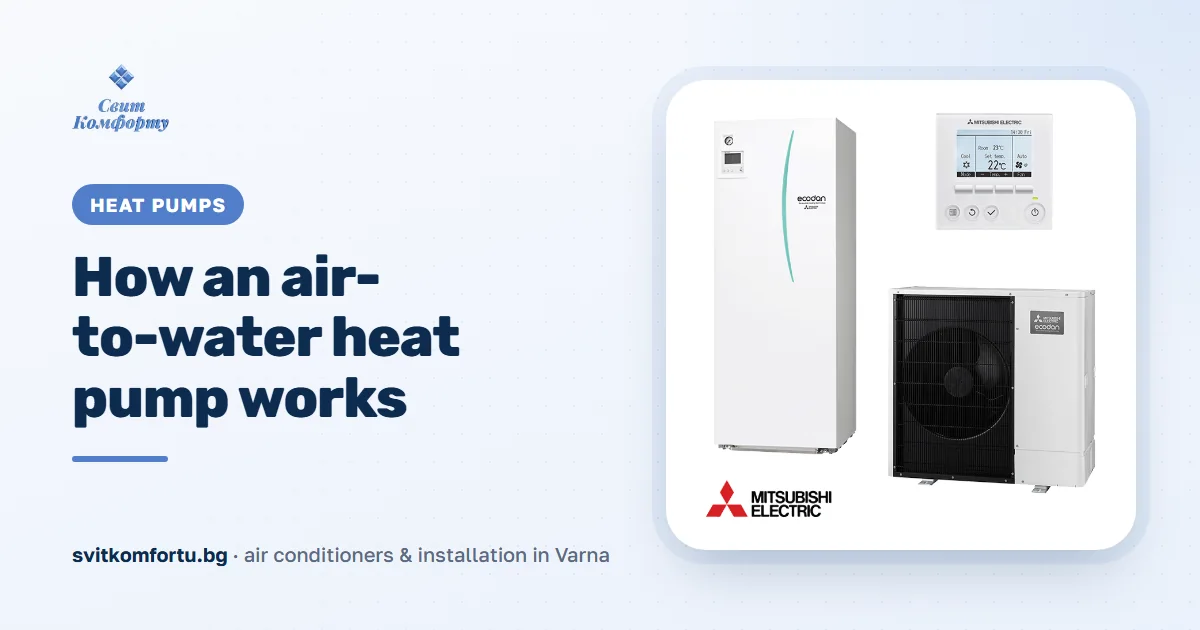
An air-to-water installation has three parts:
- Outdoor unit — fan, evaporator and compressor. It sits outdoors and runs all year round.
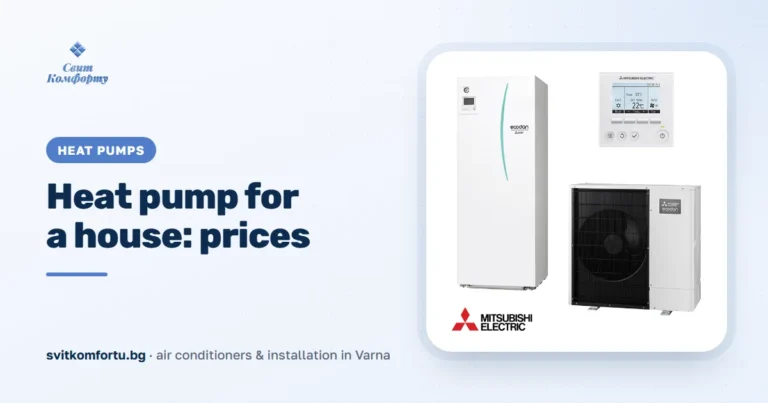
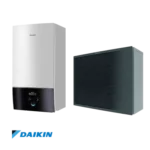
- Indoor module (hydro module) — heat exchanger, circulation pump, expansion vessel and controls. This is where the water circuit meets the refrigerant circuit.
- Distribution — underfloor heating, radiators or fan coil units, plus a domestic hot water tank if planned.
By design, units come in two types:
- Monobloc — the entire refrigerant circuit is factory-sealed in the outdoor unit; only water comes out. No on-site refrigerant work or vacuuming is needed. In our range, monoblocs number 14.
- Split — the refrigerant circuit is connected on site between the outdoor and indoor units.
Separately, 10 models come with a built-in water tank — meaning the domestic hot water tank is part of the unit and takes up no extra space.
SCOP or COP: Which Figure to Look At
On every product page you will see two coefficients, and they do not mean the same thing:
- COP is the instantaneous efficiency under one specific set of conditions (for example, +7 °C outside). A nice number for advertising.
- SCOP is seasonal efficiency — averaged over an entire heating season, including the cold days when the unit works harder.
What matters for your bill is SCOP. It tells you how many kWh of heat you get for every kilowatt-hour you pay for over the season. SCOP 5,22 means 5,22 kWh of heat from 1 kWh of electricity — in other words, a heating bill about 5 times lower than with a convector at the same comfort level.
Low-, Medium- and High-Temperature: Which One Fits Your Radiators
This is the decision that determines both the price and whether you will have to touch your existing system. A heat pump is all the more efficient the lower the water temperature it has to deliver.
| Class | Best for | Price in our range |
|---|---|---|
| Low-temperature | Underfloor heating, fan coil units, new large-surface panel radiators | from 6 664 € |
| Medium-temperature | Combined systems | from 12 054 € |
| High-temperature | Existing cast-iron or steel radiators sized for a boiler | from 15 201 € |
The difference in entry price between a low- and a high-temperature unit in our catalog is over 8 500 €. That is effectively the price of the „I won’t touch the radiators“ decision.
So before you look for a high-temperature model, run the numbers on the alternative: replacing the radiators with larger ones or installing underfloor heating, plus a low-temperature unit. In most houses the second route turns out cheaper, and on top of that you get a higher SCOP — meaning a lower bill every season for as long as the unit runs. The difference adds up.
There is one more argument in the same direction: a more expensive class does not mean a higher SCOP. The medium-temperature Daikin Altherma ETBX12E9W + EPRA12EW1 (12 054 €) operates with SCOP 4,82 — better than the high-temperature models’ 4,57. For underfloor heating the entry price is even lower: AUX ACHP-H08/4R3HA costs 3 196 €.
Why the Cheapest Unit We Sell Is Also the Most Efficient
It sounds like a mistake, but it isn’t. AUX ACHP-H08/4R3HA is both the most affordable heat pump in our range (3 196 €) and the one with the highest seasonal coefficient (SCOP 5,22). For comparison, the high-temperature Daikin Altherma at 17 340 € has SCOP 4,57.
The reason: with heat pumps, you are not paying for efficiency but for flow temperature, a built-in water tank and capacity. A unit that has to heat water to 65–70 °C for old radiators works in a harder mode — which is why it is both more expensive and has a lower seasonal coefficient than a unit for underfloor heating at 35 °C.
The practical takeaway: a high price does not mean a lower electricity bill. First decide what temperature the system will run at, and only then compare models.
Does a Heat Pump Work in Sub-Zero Temperatures?
Yes. 36 models in our range have a heating operating range down to −25 °C, and 5 of them — down to −28 °C. For the climate of Varna and Northeastern Bulgaria, that is a large margin: winter lows here rarely drop below −15 °C.
There is, however, a detail that sellers leave out. As the outdoor temperature drops, efficiency decreases: a unit that delivers a coefficient of around 5 at +7 °C runs at about 2–2,5 at −15 °C. It keeps heating and is still cheaper than direct electric heating, but not by a factor of five. That is exactly why you look at the seasonal SCOP rather than the advertised COP.
Why the Unit Stops from Time to Time: Defrost
At outdoor temperatures between about −5 and +7 °C and high humidity, frost forms on the evaporator of the outdoor unit. It hinders heat exchange, so the unit periodically enters defrostmode: it reverses the cycle for a few minutes and melts the ice. During this time, steam comes out of the outdoor unit, the fan stops and heating briefly pauses.
This is normal operation, not a fault — every air-to-water heat pump does it. It is worth knowing in advance for two reasons: there must be condensate drainage under the outdoor unit so that ice does not form on the path, and the unit itself should not be mounted flush with the ground.
How Much Electricity It Uses in Real Conditions
The math is simple proportion. For 10 000 kWh of heat per heating season:
| Source | Coefficient | Electricity used | At 0,15 €/kWh |
|---|---|---|---|
| Convector, electric stove, electric boiler | 1,0 | 10 000 kWh | 1 500 € |
| Heat pump, SCOP 4,0 | 4,0 | 2 500 kWh | 375 € |
| Heat pump, SCOP 5,22 | 5,22 | 1 916 kWh | 287 € |
The figures cover space heating only and do not include domestic hot water if it is produced by the same unit. Actual consumption depends on the building’s heat losses, the set temperature and the type of distribution.
When a Heat Pump Is Not the Right Choice
Three cases where it is worth thinking twice:
- You heat rarely and only a small area. For one room used in the evenings, an inverter air conditioner does the same job for a fraction of the investment.
- The building has no insulation. A heat pump does not compensate for heat losses — it pays for them. With a poor building envelope, insulate first.
- There is nowhere to put the outdoor unit. The unit has a fan and needs free airflow; a narrow shaft or an enclosed balcony will choke it.
What to Check Before You Order
- Power supply. In our range, 24 models are three-phase (3~/380-415 V) and 17 are single-phase. Three-phase power is not a given in every house — check it before choosing the capacity.
- Refrigerant. All units in our range with a listed refrigerant use R-32.
- Warranty. 36 months for most models, 24 months for the rest.
- Sizing. Not by floor area, but by heat loss. Oversizing is not an advantage: a unit that is too large runs in short cycles, which shortens the life of the compressor.
Frequently Asked Questions
What is the difference between an air-to-water and an air-to-air heat pump?
Air-to-water transfers heat to water and supplies underfloor heating, radiators and a hot water tank. Air-to-air (a regular air conditioner) transfers heat directly to the room air and cannot heat water.
Can a heat pump work with old radiators?
It can, but you need a high-temperature unit that supplies water at 65–70 °C. It costs more — in our range from 15 201 € versus 6 664 € for a low-temperature one — and has a lower seasonal coefficient.
What is a good SCOP?
Above 4,0 is a good level of seasonal efficiency. The highest value in our range is SCOP 5,22.
Can a heat pump also cool?
Yes, with reversible models the cycle is reversed and the same unit cools in summer. We state this in the description of each model.
How noisy is the outdoor unit?
The outdoor unit has a fan and a compressor, so it is placed away from bedrooms and the neighbors’ windows. The specific dB level is listed in the specifications of each model.
Is a buffer tank needed?
It depends on the volume of water in the system and the type of distribution. With underfloor heating, the volume is usually sufficient; with only a few radiators, a buffer is often included so the unit does not run in short cycles. This is assessed during the site survey.
Next Steps
Browse air-to-water heat pumps — 81 models from Atlantic, Daikin, KAISAI, Gree and AUX, of which 77 are for residential buildings with a capacity of 4,3–30 kW.
If your question is about price by floor area, it is covered separately in heat pump for a house — price by floor area. For a comparison with other ways of heating with electricity, see cheap electric heating, and for choosing an air conditioner for heating — air conditioner for heating.
Not sure which temperature class you need? Book a free site survey — we assess heat losses and your existing system on site before recommending a model.