
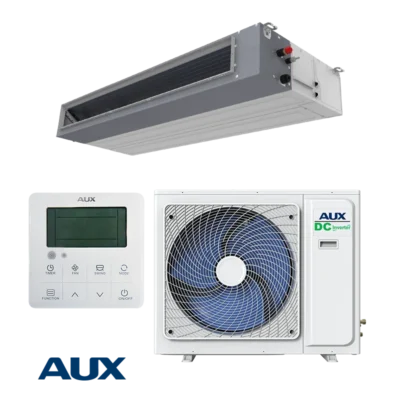
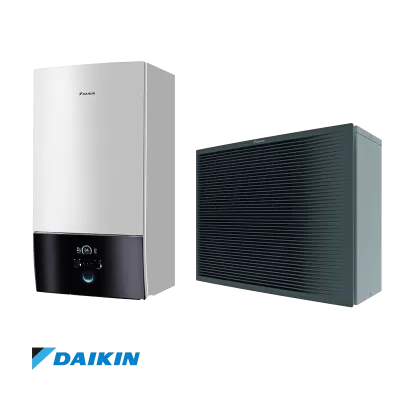


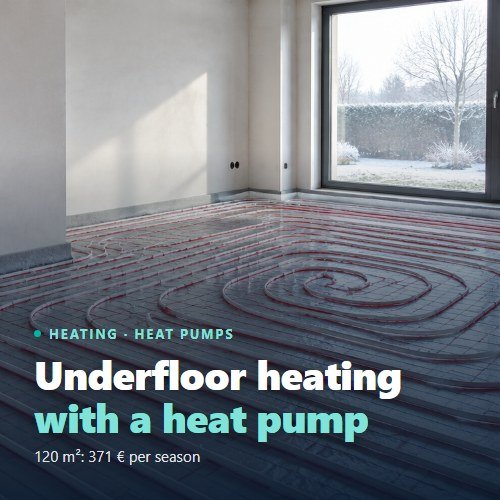
Short answer: underfloor heating is the most cost-effective partner for a heat pump. The water in it is 30–35 °C, and 35 °C is exactly where manufacturers measure the SCOP on the label. An insulated 120 m² house in Varna pays about 371 € for electricity per season this way. With the same heat pump and radiators, the bill is about 495 €. Suitable units in the catalogue start from 3 196 €.
Underfloor heating has a ceiling, though. The floor surface should not be warmer than 29 °C, so in an old uninsulated house underfloor heating alone may not be enough. Below is the calculation of when it is enough and when it is not.
Why underfloor heating and a heat pump fit together
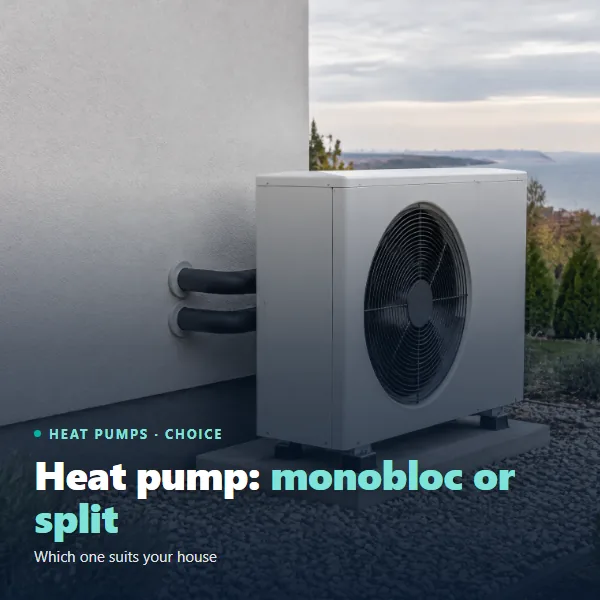
A heat pump moves heat from the cold outdoor air to the water in the system. The smaller the difference between the two temperatures, the less work the compressor does. So every degree of cooler water in the system saves electricity.
| Heating | Water temperature | Real SCOP | 120 m², electricity per season |
|---|---|---|---|
| Underfloor | 30–35 °C | about 4.0 | 371 € |
| Low-temperature radiators or fan coils | 40–45 °C | about 3.5 | 424 € |
| Old radiators | 50–55 °C | about 3.0 | 495 € |
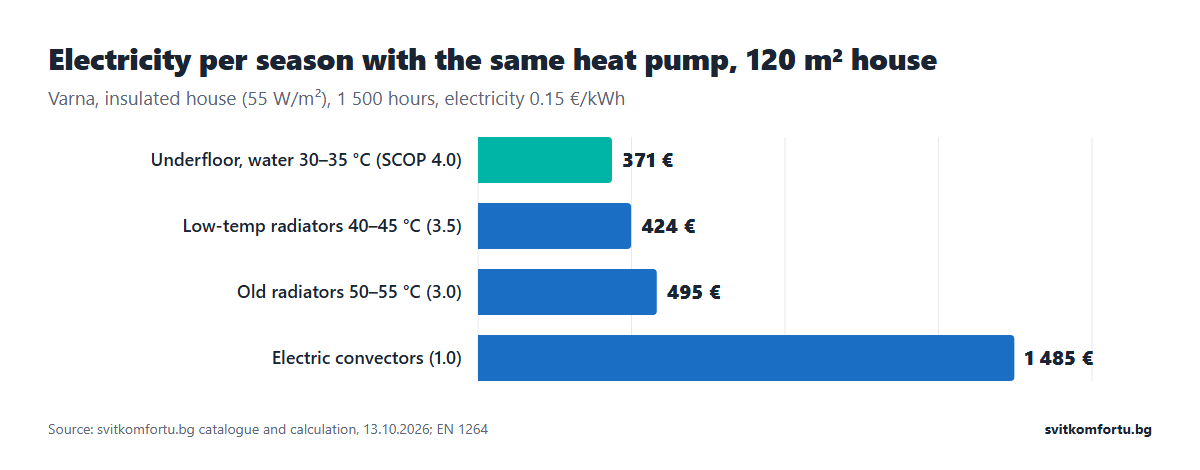
The calculation is for an insulated house in Varna: 55 W/m² heat loss, 1 500 equivalent hours per season, electricity at 0.15 €/kWh. This is the same basis as in the article how much electricity a heat pump uses, so the numbers match. The difference between underfloor heating and old radiators is about a quarter of the bill. Every winter.
Is underfloor heating enough on its own
The European standard EN 1264 limits the floor temperature in living areas to 29 °C. A warmer floor is unpleasant for the feet. With a room at 20 °C, this gives about 100 W per square metre of floor. Furniture, cabinets and bathtubs cover part of the area, so it is realistic to count on 70–90 W per square metre of the room.
Compare this with the building’s demand:
| Building | Demand, W/m² | Is underfloor alone enough? |
|---|---|---|
| Insulated after 2010 or renovated | 45–60 | yes, with a margin |
| Partial insulation, new windows | 70–90 | borderline; on the coldest days, no |
| Old uninsulated building | 100–120 | no, radiators or an air conditioner are needed to help |
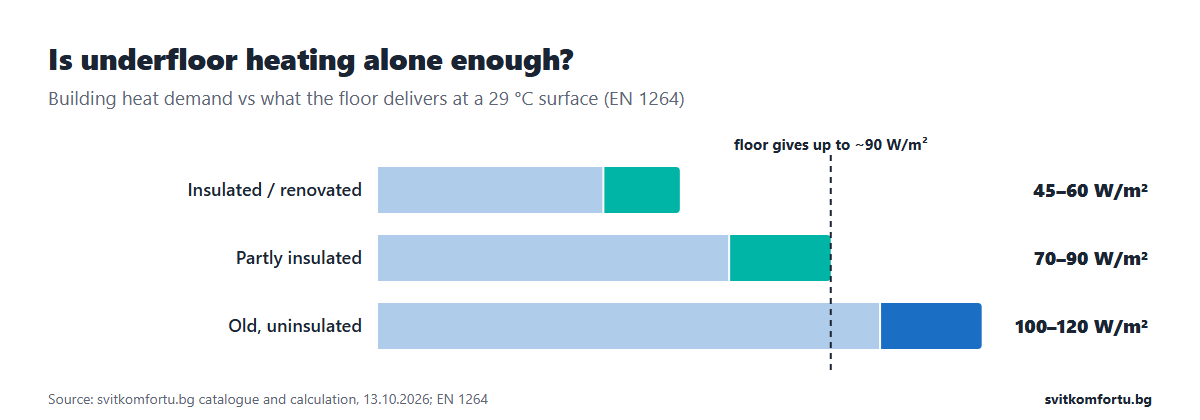
If the house is old, insulate first, then install underfloor heating. Otherwise you will pay for a system that does not keep up in January, and you will raise the water temperature. That means you lose exactly the advantage you chose underfloor heating for.
Layout of water underfloor heating with a heat pump
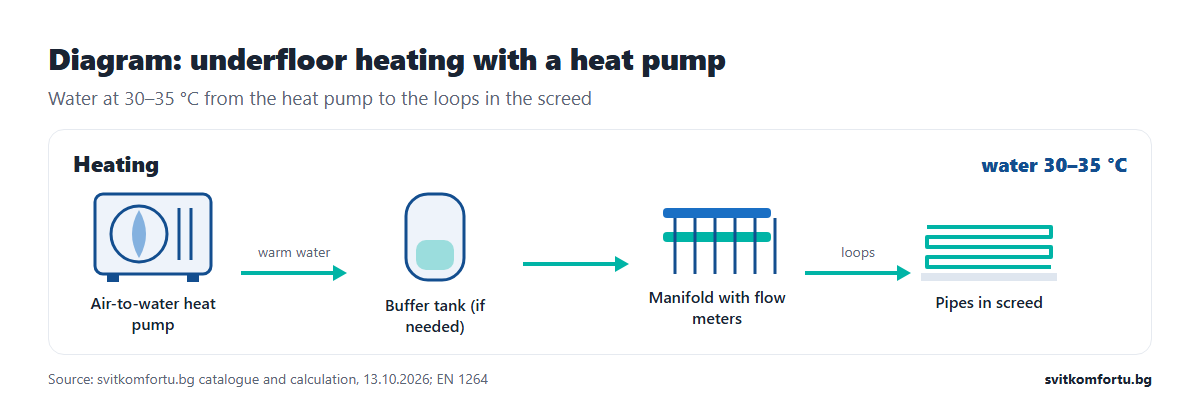
The system has five main parts:
- Air-to-water heat pump heats the water to 30–35 °C.
- Buffer tank is not always needed. It is added when there are few loops, or when room thermostats close them separately and the unit would switch on and off too often. How to choose its volume, we explain in when a buffer tank is needed.
- Manifold with flow meters distributes the water to the loops, one or two per room.
- Pipes (PE-RT or PEX, usually 16 or 17 mm) at 10–20 cm spacing on thermal insulation.
- Screed on top, then the floor covering.
A thermostat in every room is not a luxury. It closes the room’s loop when it is warm, and it saves electricity in bedrooms you want cooler. Building the underfloor heating itself (pipes, insulation, screed) is priced separately by the installer, based on the area and the condition of the floor.
Which heat pump for underfloor heating
For underfloor heating a low-temperature unit is enough. Medium- and high-temperature models cost more, and their advantage (water up to 65–70 °C) is not used with underfloor heating. A guide by area for an insulated house:
| Area | Required output | Example from the catalogue | Price |
|---|---|---|---|
| up to 120 m² | 5–7 kW | AUX ACHP-H08/4R3HA, 8.4 kW, SCOP 5.22, single-phase | 3 196 € |
| 120–180 m² | 7–10 kW | AUX ACHP-H10/4R3HA-M, monobloc 10 kW, single-phase | 3 600 € |
| 180–250 m² | 10–14 kW | AUX ACHP-H14/5R3HA, 14 kW, SCOP 4.71, three-phase | 3 998 € |
The AUX SCOP of 5.22 is measured with 35 °C water. With underfloor heating this figure is close to reality, with old radiators it is not. The full list is in the air-to-water heat pumps section, and prices by floor area are in the article heat pump for a house: price.
Can underfloor heating cool in summer
It can, but modestly. If the floor gets too cold, condensation forms on it. So the water is kept above the dew point, usually not below 18–20 °C, and the floor covers only part of the summer load. For hot days in Varna, the air conditioner remains more efficient. Many houses combine the two: underfloor heating for winter, air conditioners in the living room and bedrooms for summer.
Four mistakes that ruin the bill
- The water is set to 45 °C “just in case”. The floor becomes unpleasantly warm, and the SCOP drops toward radiator level. Set the heating curve by the outdoor temperature.
- A thick carpet or parquet without an underfloor heating marking. They insulate the floor, and the unit has to heat the water more.
- A heat pump “with a margin”, twice as large as needed. It cycles: it starts and stops often, loses efficiency and wears out faster.
- Underfloor heating in an uninsulated house without backup heating. On the coldest days it does not keep up, and the owner raises the water temperature.
What to do now
If you are building or doing a major renovation, underfloor heating with an air-to-water heat pump is the cheapest electric system to run. If the floor is finished and you will not break up the floor covering, see the article heating with a heat pump and radiators. In an apartment, see the heat pump options for an apartment block.
We install heat pumps in Varna and along the Black Sea coast. During the site visit we calculate the losses room by room and give a quote for the unit with installation. The site visit is free.
Heat pump installation in Varna: free site visit
Frequently asked questions
Is underfloor heating with a heat pump cost-effective?
Yes. For an insulated 120 m² house in Varna, electricity is about 371 € per season, against about 495 € with old radiators and about 1 485 € with convectors. The reason is the low water temperature, 30–35 °C.
What water temperature for underfloor heating with a heat pump?
Usually 30–35 °C in the coldest weather and less in mild weather. The floor in living areas must not be warmer than 29 °C under the EN 1264 standard.
Is a buffer tank needed for underfloor heating with a heat pump?
Not always. A buffer is useful when there are few loops, or when room thermostats close them separately and the heat pump would switch on too often. With an open system and enough water volume, you can do without it.
Is underfloor heating alone enough for the whole house?
For an insulated house with a demand of 45–60 W/m², yes. Underfloor heating realistically gives 70–90 W per square metre of the room. For an old uninsulated building with 100–120 W/m², no, extra heat is needed.
What heat pump output for underfloor heating of 150 m²?
For an insulated house, about 8 kW (150 m² × 55 W). A suitable example is the AUX ACHP-H10/4R3HA-M monobloc, 10 kW, for 3 600 €. For an exact output, a room-by-room heat loss calculation is done.
Can underfloor heating cool?
It can, if the heat pump has a cooling mode, but with a limit: the water must not be below the dew point, otherwise condensation forms on the floor. For hot days the air conditioner is more efficient.