






Short answer: a water-to-water heat pump takes heat from groundwater, which stays at about 10–14 °C all year round. That makes it more efficient than any other type. But it needs two boreholes, a yield test, a water analysis and paperwork with the Basin Directorate. In Varna, where winters are mild, an air-to-water heat pump from 3 196 € usually works out cheaper overall. Water-to-water makes sense in a few specific cases, listed below.
We sell and install air-to-water heat pumps, not water-to-water. So what you will find here is an honest comparison, not an ad for one system.
How a water-to-water heat pump works
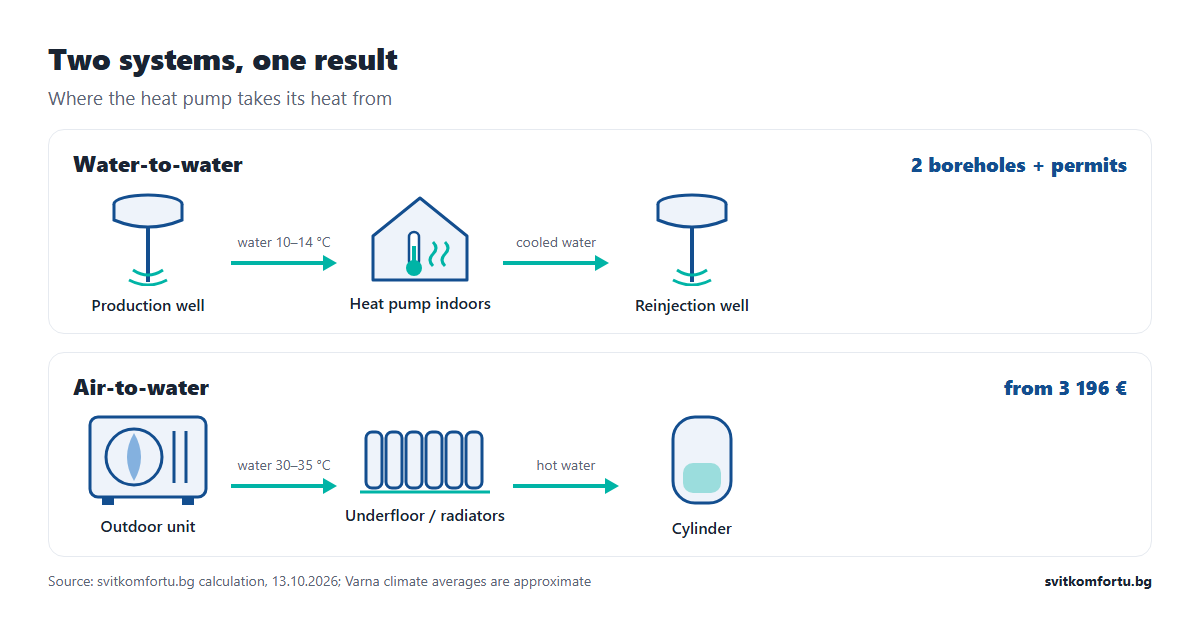
The unit sits inside the house. A submersible pump in the first borehole (the production well) sends groundwater to the heat exchanger. The heat pump takes a few degrees of heat from it and returns it to the ground through a second borehole (the reinjection well), some distance from the first. The heat it collects goes to the underfloor heating, the radiators and the hot water cylinder.
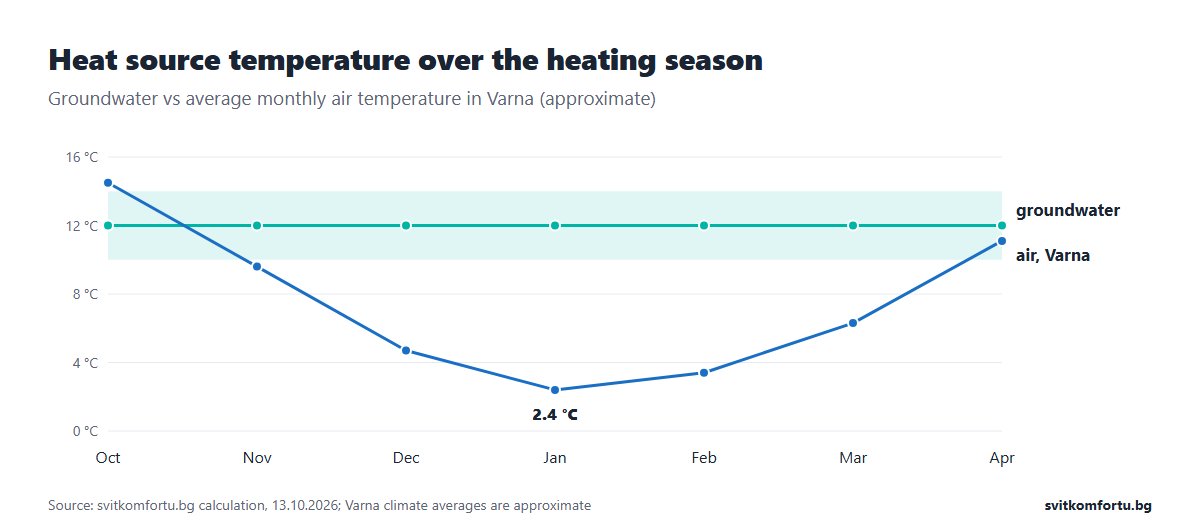
The key factor is the temperature of the source. Groundwater stays warm and stable all winter, while the air in Varna in January averages about 2–3 °C. The warmer the source, the less the compressor has to work.
Water-to-water vs air-to-water
| Water-to-water | Air-to-water | |
|---|---|---|
| Heat source | groundwater, 10–14 °C | outdoor air |
| Winter efficiency | higher and stable | drops in severe cold |
| Needed besides the unit | 2 boreholes, pump, filters, testing, water analysis | space for the outdoor unit |
| Paperwork | registration or permit with the Basin Directorate | none |
| Price | unit + boreholes on quote; the boreholes can cost more than the unit | from 3 196 € in our catalog |
| Maintenance | filters, heat exchanger, borehole yield | cleaning the outdoor unit |
| Time to start-up | months (survey, drilling, paperwork) | days |
How much water the heat pump needs
This part is skipped most often, yet it decides everything. The heat pump cools the groundwater by 3–4 degrees. To deliver 1 kW of heat to the house, it has to take about 0.8 kW from the water. That gives the required yield:
| Heat pump output | Required yield | Water per day at full load |
|---|---|---|
| 8 kW (house of about 140 m²) | about 1.4 m³/h | about 33 m³ |
| 12 kW (about 200 m²) | about 2.1 m³/h | about 50 m³ |
| 16 kW (about 280 m²) | about 2.8 m³/h | about 66 m³ |
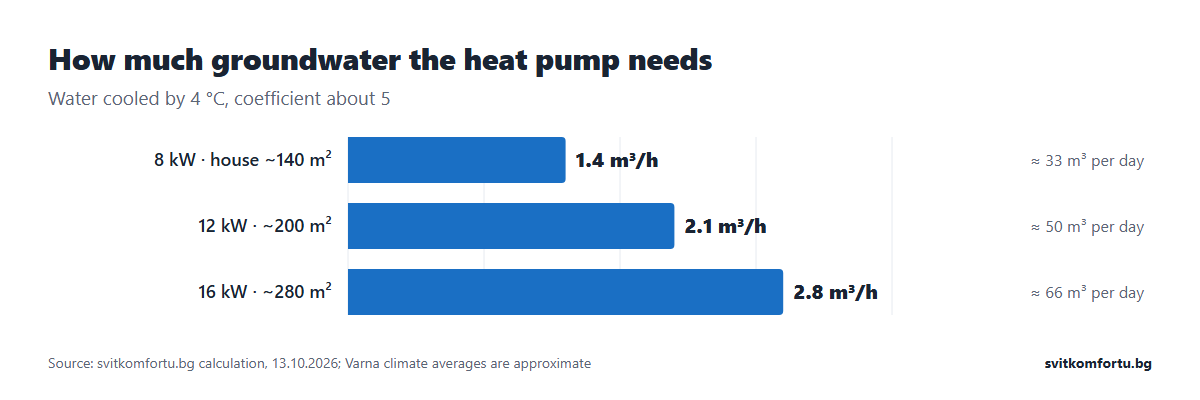
Calculated with the water cooled by 4 °C and a COP of about 5. That is tens of cubic meters a day, far more than an ordinary garden well. If the borehole cannot deliver this yield constantly, the system stops on the coldest days, exactly when you need it. That is why a pumping test is done before the design.
The borehole pump also uses electricity. With a deep borehole it eats up part of the advantage of the warmer source.
Paperwork and permits
Groundwater in Bulgaria is used under the Bulgarian Water Act. For wells, the owner must at least notify and register the installation with the basin directorate. For Varna this is the Black Sea Basin Directorate (Басейнова дирекция „Черноморски район“). An open system with a production well and a reinjection well in many cases requires a permit for water abstraction and for returning the water. The exact regime depends on the property, the volume and the purpose. Check it with the directorate or with a specialist drilling company before you order the unit.
A closed ground-to-water system (closed loop: probes with antifreeze, no water pumped) is a separate option. It does not draw water, but it also needs deep boreholes and a design.
When water-to-water makes sense
- A large house or building where the required output is over 15–20 kW and the electricity savings over the years pay for the boreholes.
- The property already has a borehole with a tested yield and a water analysis.
- The groundwater is shallow and plentiful, as confirmed by a local drilling company.
- The area has long, cold winters, where air-to-water runs for long periods below zero.
Why air-to-water usually wins in Varna
The advantage of water-to-water is greatest where the air is very cold. In Varna and along the Black Sea coast the heating season is mild: average temperatures from December to February are above zero. An air-to-water heat pump runs with a high COP for most of the season, and days at −10 °C are few.
For an insulated 120 m² house with underfloor heating, an air-to-water heat pump uses about 371 € of electricity per season. The calculation by floor area is in the article how much electricity a heat pump uses. Water-to-water can lower this amount, but over the years the savings have to cover the boreholes, the pump and the paperwork. In a mild climate and with a normal-sized house, this rarely happens.
If you are also comparing with air conditioners, see the article air-to-air heat pump. How air-to-water works is explained in how an air-to-water heat pump works.
What to do now
If the property has no borehole, start with air-to-water: it is installed in days and needs no paperwork. If there is a borehole, ask the company for the pumping test report and the water analysis. With them, you can make a fair comparison.
Air-to-water heat pumps in stock are in the heat pumps section, and prices by floor area are in heat pump for a house — price. For underfloor heating, see underfloor heating with a heat pump. We install in Varna and along the Black Sea coast. The site visit is free.
Heat pump installation in Varna: free site visit
Frequently asked questions
Which heat pump is better, water-to-water or air-to-water?
Water-to-water is more efficient, because groundwater stays at 10–14 °C all winter. Air-to-water is cheaper, faster to install and needs no boreholes or paperwork. In a mild climate like Varna’s, air-to-water usually works out cheaper overall.
How much does a water-to-water heat pump cost?
Besides the unit, you pay for two boreholes, a submersible pump, filters, a pumping test, a water analysis and paperwork. The boreholes depend on the depth and the terrain and are priced after a site visit. An air-to-water heat pump in our catalog costs from 3 196 € with no boreholes.
How much water does a water-to-water heat pump need?
About 0.17 m³ per hour for each kilowatt of heating output. For 12 kW that is about 2.1 m³/h, or about 50 m³ per day at full load.
Do you need a permit for a water-to-water heat pump?
The boreholes must at least be registered with the basin directorate. For Varna this is the Black Sea Basin Directorate (Басейнова дирекция „Черноморски район“). An open system with two boreholes in many cases also requires a permit for water abstraction and for returning the water. Check the regime for your property before the design.
Why are two boreholes needed?
Water is taken from the first, and the cooled water is returned through the second into the same aquifer. This way the groundwater level does not drop and no water is discharged at the surface.
What is a ground-to-water heat pump?
A closed system: probes with antifreeze are lowered into deep boreholes and collect the heat of the ground. No water is pumped, but deep boreholes and a design are needed, so the price is also high.