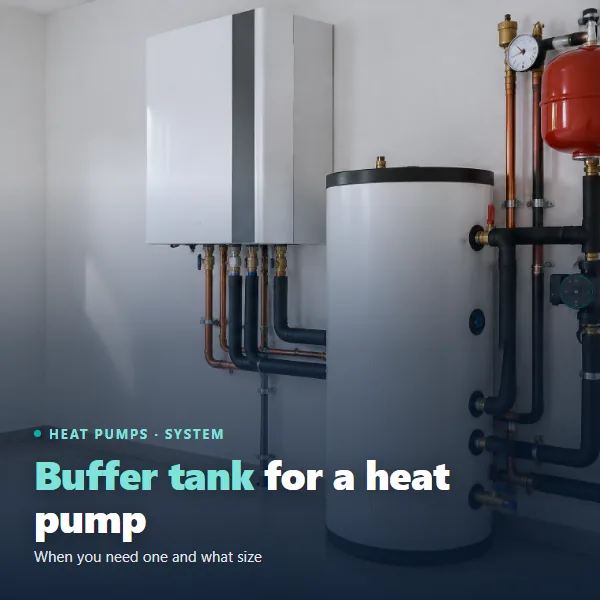
Short answer: a buffer tank is an insulated water vessel connected between the heat pump and the radiators, underfloor heating or fan coils. You need one when the system holds little water or the rooms are shut off one by one by thermostats: then the unit switches on and off in short cycles. With open underfloor heating and large cast-iron radiators you can often do without it. The volume is calculated from the manual of the specific heat pump, and we check whether a buffer is needed during a free site visit.
In the article how an air-to-water heat pump works the buffer is just one line of the diagram. Here is the full picture: what it does, when it is unnecessary, how to choose the volume and how it is connected.
What a buffer tank does
An inverter heat pump lowers its output, but not to zero. If the rooms need less heat than the unit gives at its minimum, the water heats up quickly, the compressor stops and soon starts again. This is short cycling. It wears out the compressor and raises the bill; we describe it in more detail in heat pump running costs. The buffer adds a volume of water that stores the surplus heat, so the cycles get longer.
It has three more jobs:
- Defrosting. In winter the outdoor unit defrosts from time to time and takes a little heat from the water to do it. With a larger volume you hardly notice the pause in the rooms.
- Separating the circuits. When radiators, underfloor heating and fan coils need different flow rates, the buffer lets each circuit have its own pump.
- A second heat source. If a pellet or wood boiler stays, both sources are connected to one system, usually through a buffer. This setup is described in heat pump or pellets.
When you need one and when you can do without
| System | Buffer tank |
|---|---|
| Underfloor heating, loops open, no thermostat on each loop | Usually not needed |
| Underfloor heating, each loop closed by a room thermostat | Often needed |
| Old cast-iron radiators with a large water volume | Usually not needed |
| Small panel radiators or a few fan coils | Often needed |
| Heat pump plus a pellet or wood boiler | Almost always |
| Several circuits with different pumps (underfloor, radiators, fan coils) | Almost always |
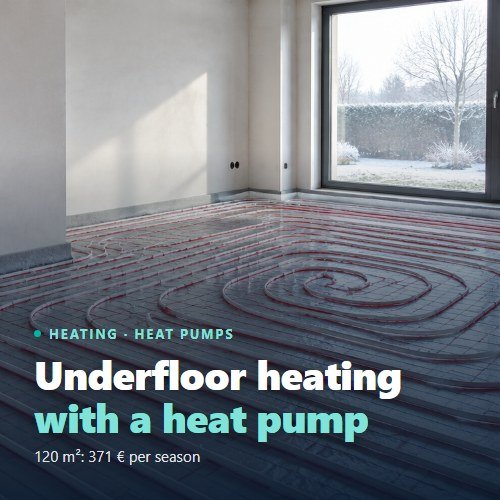
The table is a guide. Details for underfloor heating are in underfloor heating with a heat pump, and for radiators in heating with a heat pump and radiators. The decision depends on the specific unit and on how much water stays in the circuit when the thermostats close.
How to choose the volume
The floor area of the house does not help here. In the manual of every heat pump the manufacturer states the minimum water volume the circuit must hold. From that minimum we subtract the water that always circulates: the pipes and the emitters that the thermostats do not close. The difference is the buffer volume, rounded up to the next standard size.
A hypothetical example: the manual asks for at least 60 l, and the open emitters and pipes hold about 35 l. That leaves 25 l short, so you fit the nearest standard buffer above that. Shops sell buffers from 50 to 500 l, and the most searched sizes are 80, 100, 150 and 200 l. A bigger one than needed brings no benefit: it takes space, loses more heat and warms up more slowly.
That is why during the visit we look at the unit model, the number of emitters and how many loops have thermostats. We name the volume after we see them.
Series or parallel connection
- Series (the buffer sits in the return line). It only adds volume, works with one pump and does not lower the temperature going to the rooms. It suits cases where the only goal is to stop short cycling.
- Parallel (with four connections). The buffer separates the heat pump circuit from the room circuit, and each runs with its own pump. It is needed with several circuits, with thermostatic valves everywhere and with a second heat source. The downside is that the water mixes and the unit has to heat a little hotter.

Which layout fits depends on the system you already have. If you are still choosing a unit, see also the comparison monobloc or split heat pump: it describes what goes inside the house with each type.
Heat pumps with a built-in buffer tank
Some models have a buffer inside the indoor unit. In our catalogue these are Atlantic ALFEA EXTENSA with a built-in 16 l buffer tank and ALFEA EXCELLIA with 16 or 24 l, according to the model description. Prices are from 4 597 €. The DUO versions also have a built-in 190 l hot water cylinder, and their prices are from 6 642 €.
An external buffer is added to these models when needed, by the same rules as for any heat pump: when there are few loops or they close one by one, with a pellet boiler or with several circuits with separate pumps. Whether the built-in volume is enough is calculated the same way: the minimum from the manual minus the water in the circuit.
Buffer for cooling and with a coil
If the heat pump will cool in summer, cold water flows through the buffer. Then it must have insulation against condensation, otherwise water collects on its walls. A buffer with a coil is for a second heat source, such as a solar collector: its water runs through the coil and does not mix with the heating water.
Price and a free site visit in Varna
We supply and install buffer tanks together with heat pump installation. The price of the buffer and its connection depends on the volume, the layout and the system, so we give it after a free site visit, together with the price of the whole system. What the work includes is described on the page heat pump installation in Varna, and the models are in the section air-to-water heat pumps. A guide price for the whole system by floor area is in heat pump for a house – price.
Frequently asked questions
Is a buffer tank mandatory for a heat pump?
No. You need one when the system holds little water, the rooms are closed by thermostats or there is a second heat source. With open underfloor heating and enough volume you can often do without it.
Which buffer tank do I need: 100 or 150 litres?
The volume is the minimum water volume from the heat pump manual minus the water that always circulates in the pipes and emitters. That is why the size is set after a site visit, not by floor area.
What happens if a heat pump runs without a buffer and the water volume is small?
The unit switches on and off in short cycles. This wears out the compressor and raises electricity use.
Are there heat pumps with a built-in buffer tank?
Yes. In our catalogue Atlantic ALFEA EXTENSA and ALFEA EXCELLIA have a built-in 16 or 24 l buffer tank. An external buffer is added when needed, for example when thermostats close the loops one by one.
How much does a buffer tank with installation cost?
It depends on the volume, the connection layout and the system. We give a price after a free site visit, together with the heat pump installation.