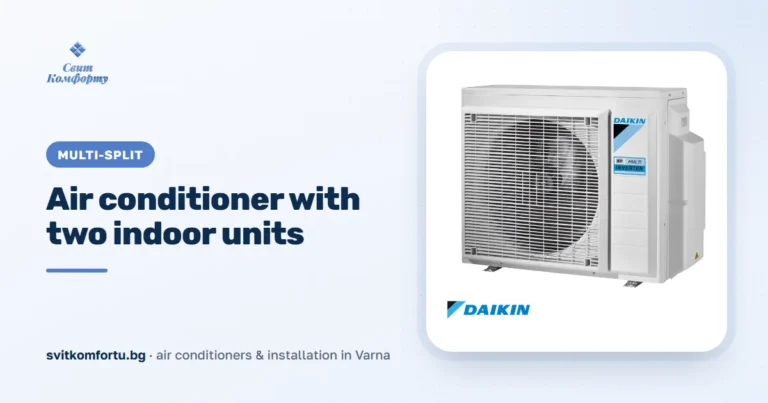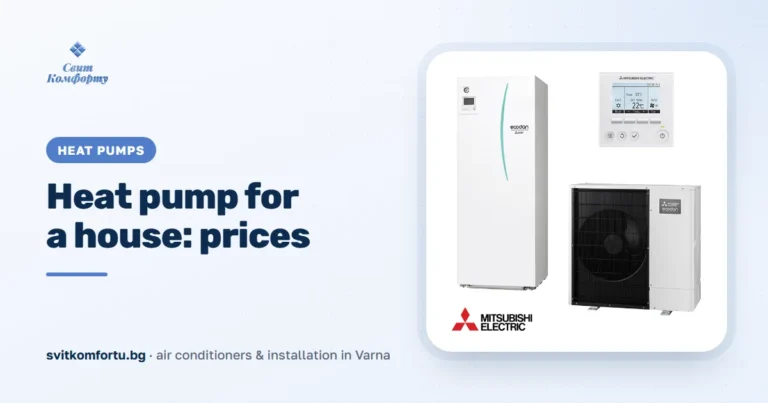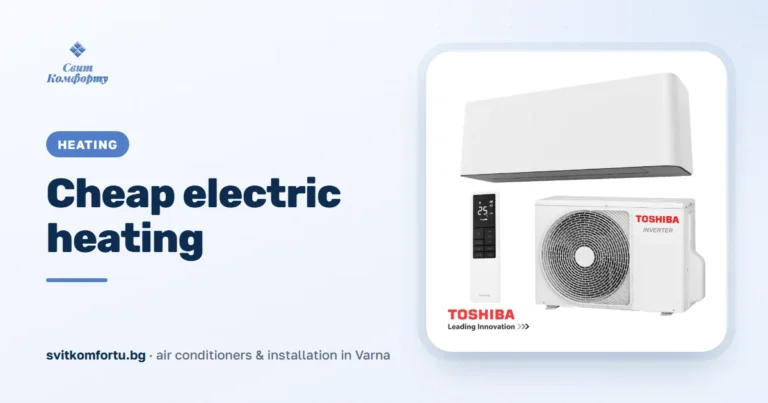
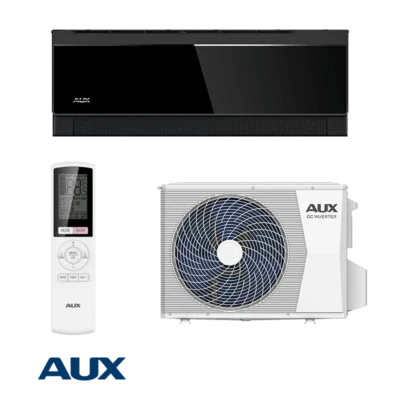
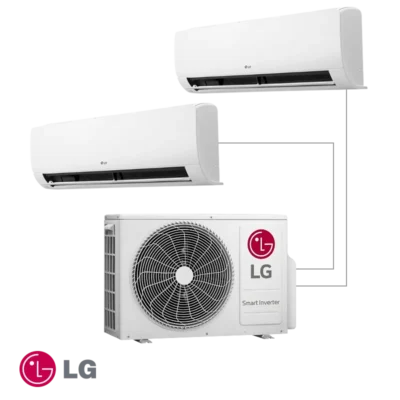
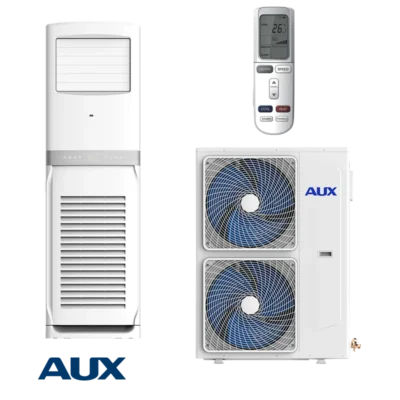
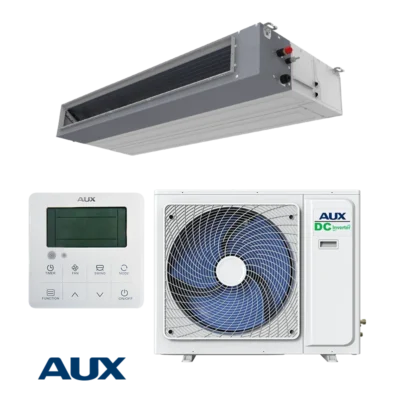
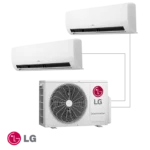
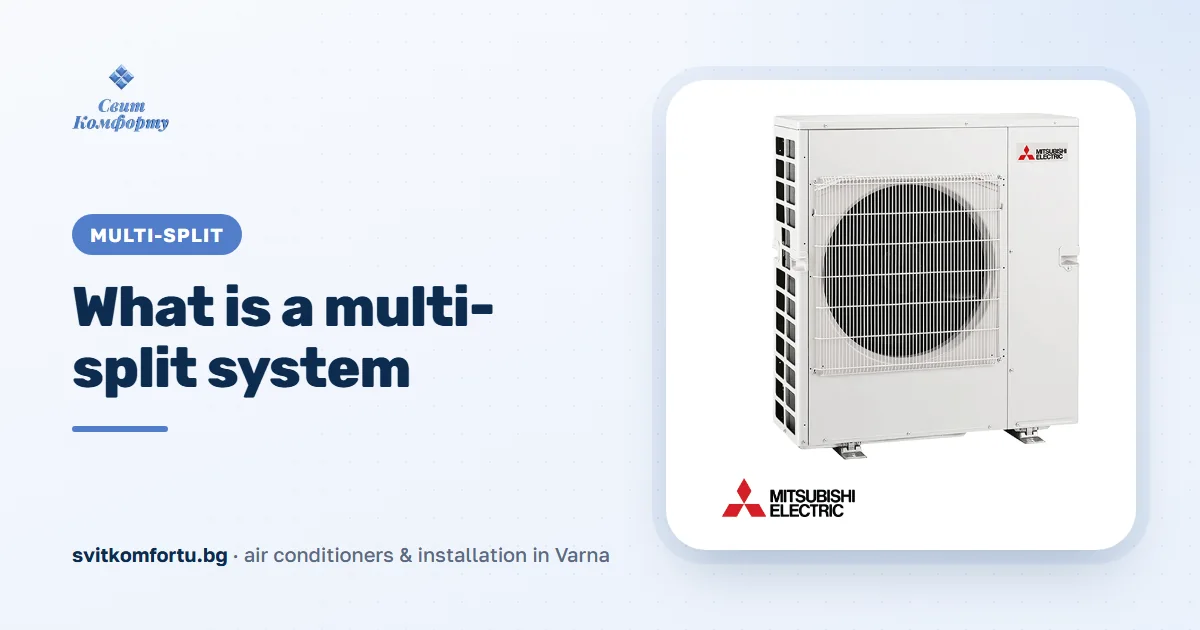
A multi-split system is an air conditioner in which one outdoor unit serves several indoor units, usually 2 to 5, each in a separate room. Each indoor unit is controlled independently and has its own temperature setting. All of them, however, share one refrigerant circuit and one compressor outside.
That is where both the advantages and the limitations come from — including three limitations almost nobody warns you about in advance.
Split, Multi-Split and VRF
These three terms get mixed up all the time. The difference comes down to one number: how many indoor units hang off a single outdoor unit.
| Type | Outdoor units | Indoor units | Typical use |
|---|---|---|---|
| Split system | 1 | 1 | A single room, the ordinary air conditioner |
| Multi-split system | 1 | 2 to 5 | Apartment, small house, office |
| VRF / VRV | 1 | from 8 to dozens | Hotel, office building |
“Split” simply means “divided.” The machine is divided into a noisy part outside (compressor, fan) and a quiet part inside. “Multi” just adds that there are several indoor parts. Technologically, a multi-split is not fundamentally different from an ordinary air conditioner. It is the same thing, only with more outlets.
How It Works
The outdoor unit houses a compressor that moves refrigerant (R-32 in current series) around a closed loop. Separate copper lines run from the compressor to each indoor unit. Each unit has its own fan, heat exchanger and electronic valve that opens or closes the refrigerant flow to it.
If you turn on the air conditioner only in the bedroom, the valve to the living room stays closed. Refrigerant goes only where it is needed, and the inverter compressor slows down to just what one room requires.
This is exactly where the technical strength of the solution lies. An inverter compressor is most economical at partial load, and a multi-split runs at partial load most of the time. That is why the seasonal ratings of good systems are high: SEER from 6.1 to 8.09 and SCOP from 4.0 to 4.6 for the models in stock.
What „Up to 2“, „Up to 3“, „Up to 5“ Indoor Units Means
Every outdoor unit has a factory-set maximum number of connections. This is the first thing to check when choosing, and manufacturers usually encode it right in the model name:
- AUX AM2-H14: the digit after AM is the number of indoor units, i.e. up to 2.
- AUX AM3-H21: up to 3 units, 21,000 BTU.
- KAISAI K2OE-18HFN32H: two-room system, 18,000 BTU.
- Toshiba RAS-2M14G3AVG-E: 2 units, 14,000 BTU.
The number after the letter H or M is usually the capacity in BTU. The consequence is important: an outdoor unit for two indoor units cannot be expanded to three. If there is any chance you will want to air-condition another room later, get an outdoor unit for three from the start. The price difference now is far smaller than replacing the entire outdoor unit later.
Why the Outdoor Unit’s Capacity Is Not the Sum of the Indoor Units
This confuses almost everyone who does the math on their own. Logic suggests that two 9,000 BTU units need an 18,000 BTU outdoor unit. In practice the system is sized on a different principle: diversity (simultaneous demand).
Two rooms very rarely need maximum output at the same moment. While the living room is being cooled at 3 p.m., the bedroom is empty. While the bedroom runs at night, the living room is off. That is why manufacturers allow the combined capacity of the indoor units to exceed the outdoor unit’s capacity, usually by 20 to 30%.
An example from our catalog. The outdoor unit AUX AM2-H14/4DR3 is rated at 14,000 BTU and 4.1 kW cooling capacity. Two AMWM-H07 units of 7,000 BTU each add up to exactly 14,000 — a one-to-one match that covers 30 m². But according to its documentation, the same outdoor unit also works with larger indoor units, as long as the total stays within the permitted range.
The practical rule: don’t do the math yourself. Permitted combinations are explicitly listed in each model’s technical documentation. A mistake here doesn’t show up right away. It shows up on the hottest day of the year, when both rooms demand maximum output and the system can’t keep up.
Three Limitations Rarely Mentioned
First: one mode for all rooms. Residential multi-split systems run on a shared refrigerant circuit. That means you cannot cool the living room and heat the bedroom at the same time — the mode is shared by the whole system. A separate temperature for each room, yes. A separate mode, no.
This is not a theoretical limitation. In an apartment with south- and north-facing windows, in spring and fall one room wants cooling while the other wants heating. If your home is like that, two separate split systems will serve you better than one multi-split.
Second: a shared outdoor unit means a shared breakdown. If the compressor outside stops, every room stops at once. With two separate air conditioners, the second one keeps running while you wait for the first to be serviced.
Third: you are tied to one brand and series. The indoor units must be compatible with the outdoor unit, meaning from the same manufacturer and the matching series. You cannot add a unit from another brand, even if its capacity is right.
Types of Indoor Units
One of the real advantages of a multi-split is that the indoor units don’t have to be identical, either in capacity or in type. Here are actual prices by type from our current catalog:
| Indoor unit type | Where it is used | Price from |
|---|---|---|
| Wall-mounted | Most common, above a door or window | 172 € |
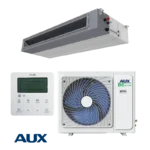
| Ducted | Hidden in a suspended ceiling, only the grille is visible | 384 € |
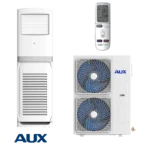
| Floor | Under a window when the wall is taken | 403 € |
| Cassette | In a suspended ceiling, distributes air in four directions | 434 € |
Wall-mounted units are both the cheapest and the easiest to install. Ducted and cassette units need a suspended ceiling and must be planned at the renovation stage. Once the ceiling is finished, it is too late.
When a Multi-Split Is the Right Choice
It makes sense when the facade allows only one outdoor unit — for example, when the condo association, the developer or heritage protection rules require it. It also makes sense when there is physically no room for two units: a narrow balcony, a short stretch of facade. It makes sense if you prefer one unit on the facade instead of two for aesthetic reasons, or if you are air-conditioning three or more rooms in a home with limited facade space.
It doesn’t make sense if you are after the lowest price. Two separate split systems come out about 450 to 550 € cheaper for the same capacity. It also doesn’t make sense when the rooms face different directions and often need different modes, or when you are only air-conditioning two rooms and have space for two outdoor units. And it certainly doesn’t make sense if you don’t want every room to depend on one machine.
How Much It Costs
For two rooms, equipment starts from 1 052 € for a mix-and-match set and 1 360 € for a ready-made factory kit. An outdoor unit for three rooms starts at 940 €, for four at 1,329 €, and for five at 1,825 €. These prices are for the outdoor unit only, without a single indoor unit.
The full breakdown by kit, an honest comparison with two separate air conditioners and a table of all available outdoor units are in a separate article: air conditioner with two indoor units — kits and prices.
The full selection, 105 outdoor and indoor unit items, is in the multi-split systemscategory. If you are still sizing your rooms, start with how many BTU you need. For installation in Varna, see our service— the site survey is free.
Frequently Asked Questions
What is a multi-split system?
An air conditioning system in which one outdoor unit serves several indoor units, usually 2 to 5, each in a separate room with its own controls and temperature setting.
What is the difference between a split and a multi-split?
A split system is one outdoor unit and one indoor unit. A multi-split is one outdoor unit and several indoor units. The technology is the same; the difference is the number of outlets on the outdoor unit.
How many indoor units can one outdoor unit have?
For residential systems, 2 to 5 depending on the model. The number is set at the factory and cannot be increased after purchase.
Can each room have a different temperature?
Yes. Each indoor unit is controlled independently and has its own set temperature. Only the mode is shared — cooling or heating for the whole system.
Is a multi-split system more economical than several separate air conditioners?
In electricity use it is comparable; the seasonal ratings are in the same range. In purchase price it is not — a multi-split costs more. The gain is one outdoor unit on the facade, not a lower power bill.
Does a multi-split system work for heating?
Yes, all modern models use a heat pump cycle and provide heating. The series in stock heat down to −15 °C, and some down to −20 °C.
Can the indoor units be of different types?
Yes — for example, a wall-mounted unit in the bedroom and a cassette in the living room, as long as they are compatible with the outdoor unit. This is one of the real advantages of a multi-split.