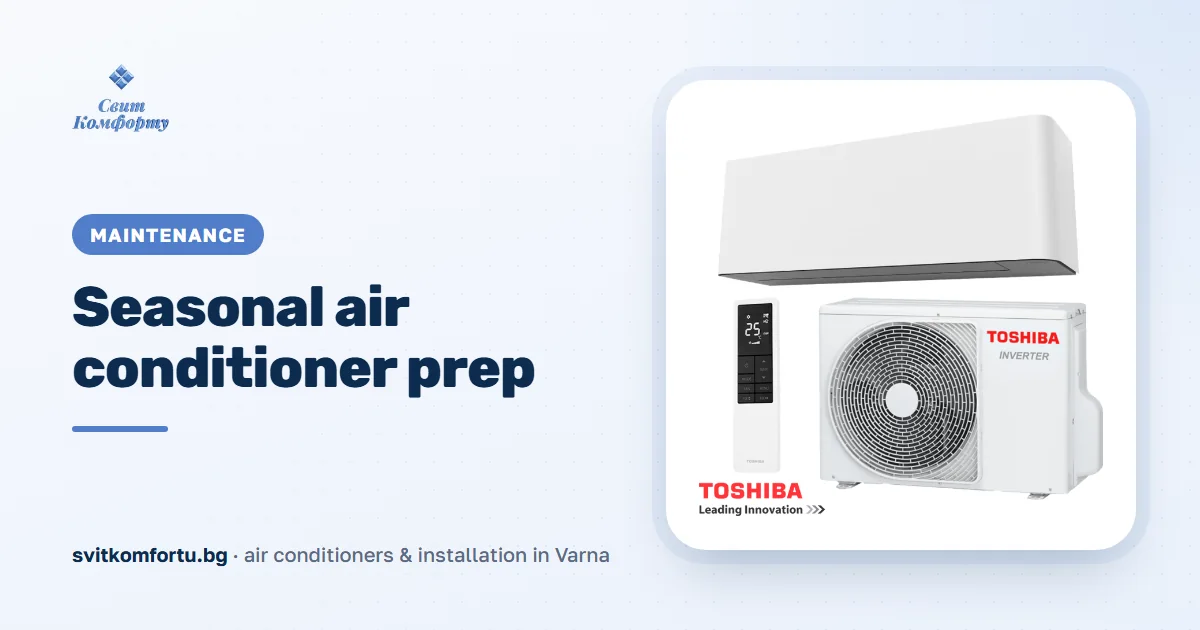
Half an hour of work twice a year. That’s all it takes to use less electricity, breathe cleaner air and avoid being left without air conditioning on the very day you need it most. Below: what to do, when, and what to leave to a technician.
Why bother at all
An air conditioner works hardest when you rely on it most — in a hot August and a cold January. Dirty filters, a clogged outdoor unit or low refrigerant make it run flat out, use more electricity and wear out faster. That’s exactly why breakdowns rarely happen in spring. They happen at the peak of the season, when service companies are overloaded and repairs are both more expensive and slower. Preparation isn’t complicated, and most of it you can do yourself. What you gain:- Up to 25% lower power bills. A clean air conditioner with a normal refrigerant level simply works less for the same result. To see exactly how much yours uses, check how much electricity an air conditioner uses.
- Cleaner air. Dust, bacteria and mold collect in the heat exchanger and filters. For a home with small children or someone with allergies, this isn’t a cosmetic issue.
- Longer life. A well-maintained air conditioner lasts 12–15 years. A neglected one — 7–8.
- A valid warranty. Most manufacturers require proof of annual maintenance; otherwise they won’t honor warranty repairs.
How it works in brief (and why it matters)
An air conditioner doesn’t „make“ cold or heat. It moves it. In summer it pumps heat from the room outdoors; in winter it does the opposite — it takes heat from the outdoor air and brings it inside. All of this happens through refrigerant circulating between the two units. The bigger the difference between indoor and outdoor temperature, the harder the compressor works. +35°C outside and +24°C inside, or -5°C outside and +22°C inside — that’s maximum stress for the unit. Add a clogged filter or a dusty coil, and the stress doesn’t grow linearly — it jumps. That’s why the difference between a prepared and an unprepared air conditioner shows most on the extreme days, not the mild ones. If you’re still choosing a unit, the articles how to choose an air conditioner and inverter vs. hyper-inverter explain the differences without unnecessary jargon.☀ Getting ready for summer
The best time is April–May, before the first heat. That way you catch any problem now, not on a day when it’s 38°C outside.- The filters. This is the step with the biggest impact — and the one people skip most often. Open the cover, take out the mesh filters, wash them in lukewarm water with a little dish soap and let them dry completely in the shade. During the season, repeat every 2–4 weeks. That’s it.
- The outdoor unit. Over the winter, leaves, dust and poplar fluff collect in its coil. Disconnect the unit from power and clean the fins with a soft brush or low-pressure water. No pressure washer — it bends the fins and the air conditioner loses efficiency. Leave at least 30 cm of clear space around the unit.
- The drain. A clogged drain line is the number one cause of water dripping from the indoor unit. Run a little water through it and check that it drains freely outside.
- Test. Run it at 16–18°C for 10–15 minutes. You should feel cold air within five minutes, with no strange noises or smells. Smells damp or musty? The heat exchanger needs professional disinfection.
- Signs of low refrigerant. Weak cooling despite clean filters, ice on the copper lines, the unit running for a long time without reaching the set temperature — that’s a leak. Stop here and call a technician; handling refrigerant is legal only for certified professionals (F-Gas Regulation).
- The thermostat. A difference of 6–8°C between indoors and outdoors is optimal. A lower setting doesn’t cool faster — it just loads the compressor and raises the bill. More on sensible use in air conditioners for cooling.
💡 Is your air conditioner cooling worse than before even though it’s clean? Sometimes the problem isn’t maintenance but capacity — especially if you’ve changed how the room is used or added glazing. Check with the capacity selection calculator or see how many BTU you need.
❄ Getting ready for winter
More and more people in Bulgaria heat with an air conditioner, and that’s perfectly sensible — inverter models are among the cheapest ways to heat. Winter has its own quirks, though. Time to prepare: September–October.- Filters and unit again. „But I cleaned them in spring“ doesn’t cut it — after six months of cooling, the filters are full of dust again. Clean unit = efficient heating.
- Test heating in advance. Heat at 28°C for 10–15 minutes. Warm air within 5–10 minutes. If the inverter unit starts slowly or runs short defrost cycles (steam from the outdoor unit), that’s normal, not a fault.
- Snow protection. An exposed outdoor unit needs a canopy against falling snow and icicles. But don’t cover it completely — it needs airflow even in heating mode.
- Drain heating. On models rated for heating below -7°C, condensate drains through a line with a heating cable. If it freezes, the unit locks up.
- Cold resistance. This is the important decision. Ordinary on/off air conditioners heat efficiently only down to about -7°C. For harsher winters you need an inverter model with guaranteed heating down to -15°C, -25°C or -30°C. If you plan to heat mainly with an air conditioner, browse air conditioners for heating and energy-saving models.
Checklist: summer vs. winter
| Task | Before summer | Before winter |
|---|---|---|
| Filter cleaning | ✔ mandatory | ✔ mandatory |
| Outdoor unit cleaning | ✔ | ✔ |
| Cooling mode test | ✔ | — |
| Heating mode test | — | ✔ |
| Drain check | ✔ | ✔ (+ heating) |
| Snow/ice protection | — | ✔ |
| Refrigerant check | ✔ (service) | ✔ (service) |
| Heat exchanger disinfection | ✔ (service) | recommended |
| Electronics and remote check | ✔ | ✔ |
| Professional maintenance | 1× a year (minimum) | 2× recommended |
What to do when throughout the year
So you don’t miss anything, here’s a simplified calendar for the Bulgarian climate:| Period | What to do |
|---|---|
| April – May | Full summer prep + annual professional maintenance. |
| June – August | Filters every 2–4 weeks. Watch for weak cooling and new noises. |
| September – October | Winter prep: filters, heating test, protection and drain heating. |
| November – February | Filters once a month. Clear snow and ice around the outdoor unit. |
| March | Quick check and scheduling the annual maintenance. |
How exactly to clean the filters
Since this is the task with the biggest impact, here it is in detail:- Turn off the air conditioner with the remote and unplug it from power.
- Lift the front cover of the indoor unit — it usually clicks upward.
- Pull out the mesh filters. They slide out without force.
- Vacuum off the coarse dust, then rinse under running lukewarm water with a little detergent.
- Let them dry completely in the shade. A wet filter back in the unit = mold within a week.
- Put them back, close the cover, switch on.
The outdoor unit needs attention all year
It’s the most vulnerable part, because it sits outside in all weather. Besides the seasonal checks, follow a few simple rules:- At least 30 cm of clear space around it. Don’t box it in with furniture, planters or building materials.
- Nothing on top. Vibration shifts objects, and they end up blocking the fan.
- After a storm or snowfall, check for leaves, branches and piled-up snow.
- If the unit sits on the ground, raise it on brackets so it isn’t standing in a puddle or snowdrift.
- Once a year, have a technician inspect the mounting, the dampers and the electrical connections.
When it’s a job for a technician
Home maintenance covers most needs. But there are cases where a certified technician is a must:- It doesn’t cool or heat enough even though the filters are clean.
- Ice on the copper lines or water dripping from the indoor unit.
- Strange noises, strong vibrations or a burning smell.
- The unit shuts itself off, restarts or shows an error code.
- More than 12 months without professional maintenance.
- Suspected refrigerant leak — only a technician is allowed to top up refrigerant.
The math on maintenance
Not sure about paying €31–46 for annual maintenance? The math is simple. A dirty air conditioner uses 15–25% more electricity. For a home that uses the unit for both cooling and heating, that’s dozens of BGN a month during the active seasons. Maintenance pays for itself in the first season — and that’s before counting the repairs you avoid. There’s a second benefit too: a well-prepared air conditioner holds the temperature more steadily, cycles the compressor less and is simply more comfortable. You’ll find specific numbers in our articles on power consumption and energy-saving air conditioners.When no amount of maintenance helps
Sometimes the unit is simply old or undersized for the room, and nothing can make up for it. Signs it’s time for a new one: frequent expensive repairs, a higher bill despite maintenance, noise that won’t go away, or an inability to hold a comfortable temperature on the hottest and coldest days. Before choosing a new one, determine the exact capacity with the capacity calculator and check out how to choose an air conditioner and air conditioners for 60 m². To help pick a brand, see the comparison Daikin vs. Mitsubishi and the reviews of Kaisai and AUX. The full range is in our online shop.The mistakes we see most often
- Washing filters in hot water. It warps the plastic. Lukewarm only.
- Putting wet filters back in the unit. Guaranteed mold and odor.
- Wrapping the outdoor unit completely for winter. It blocks airflow and strains the compressor.
- Neglecting the drain. One of the most common causes of damage to walls and furniture.
- Pressure-washing the outdoor unit. It bends the fins.
- Topping up refrigerant „by eye.“ Illegal and dangerous — technicians only.
- Skipping annual maintenance. You save €31–46, risk a repair costing hundreds and lose the warranty.
Frequently asked questions
How often should I clean the filters?Every 2–4 weeks with active use. With a pet, a smoker in the home or a dusty environment — more often. Off-season, once a month is enough.
Can an air conditioner heat in winter in Bulgaria?Yes, and cheaply. For colder areas, choose a model with guaranteed heating down to -15°C or lower. Details in air conditioners for heating.
Should I unplug the air conditioner in winter if I’m not using it?It’s not mandatory, but it’s good practice for long periods without use — it protects the electronics during thunderstorms.
How much does annual maintenance cost?Roughly €31–46 for a residential split. The exact price depends on the type and accessibility of the unit — for a quote, write to us.
Is it dangerous to clean my air conditioner myself?The filters and visible parts are safe as long as the unit is disconnected from power. Refrigerant, electronics and disassembly — leave those to a technician.
Why does it smell bad when I switch it on?Usually it’s mold in the heat exchanger from trapped moisture. It’s fixed with professional disinfection, which removes the cause, not just the smell.
How often is servicing needed?At least once a year. If you use the unit year-round — twice, before summer and before winter.