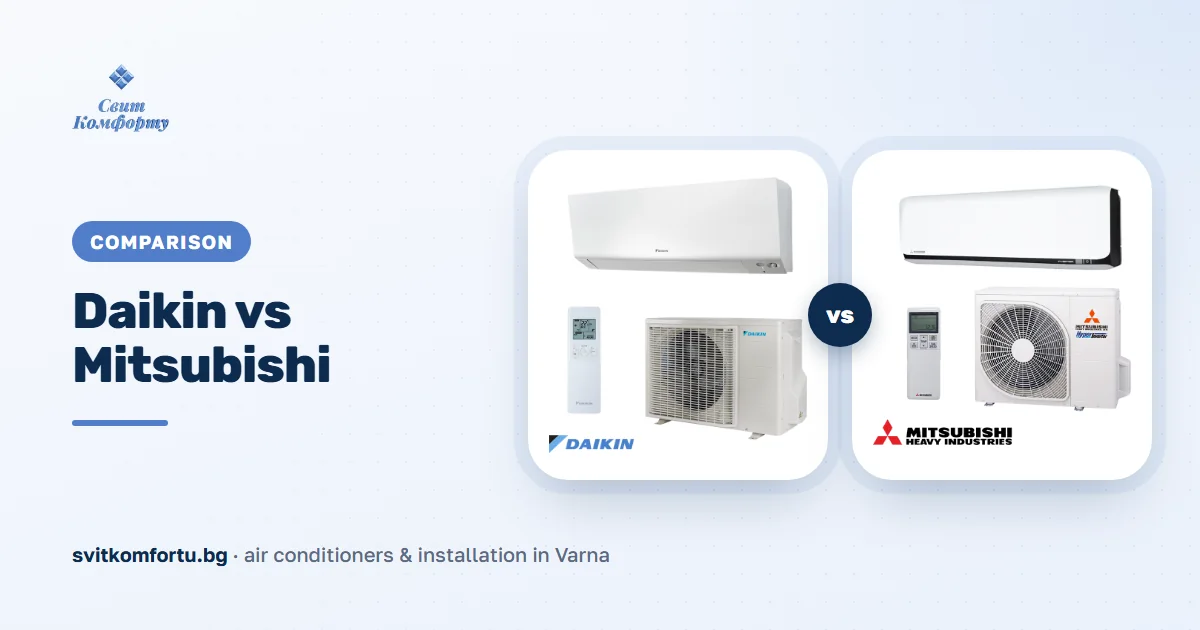
The History of Daikin and Mitsubishi
Japanese air conditioners are known worldwide for their reliability, high build quality and constant technological innovation. That is exactly why the comparison of Japanese air conditioners Daikin vs Mitsubishi is so popular among consumers looking for an efficient, long-lasting air conditioning system. If you would like to explore more manufacturers and models, you can visit the page on air conditioning equipment brands.
Both manufacturers have a long history in the development of air conditioning equipment and are among the most influential companies in the industry. Thanks to decades of experience, continuous investment in research and development and high quality standards, Daikin and Mitsubishi Electric have established themselves as global leaders in heating and cooling.
Daikin
Daikin was founded in 1924 in Japan and today is one of the largest manufacturers of air conditioning equipment in the world. The company specializes entirely in air conditioning systems and constantly develops innovative technologies for higher energy efficiency and comfort.
- over 90 years of experience in the air conditioning industry
- presence in more than 150 countries
- a leader in inverter technology development
- a strong presence on the European market
- investment in innovation and eco-friendly solutions
Mitsubishi Electric
Mitsubishi Electric was founded in 1921 and is part of the large Mitsubishi industrial group. The company has an exceptionally strong engineering tradition and is known for making reliable, durable air conditioning systems that run steadily even in extreme climate conditions.
- more than 100 years of engineering history
- exceptionally reliable and durable systems
- high-quality components
- innovative heating and cooling technologies
- strong development of smart climate solutions
Quality and Reliability
When comparing daikin vs mitsubishi electric, build quality and long-term reliability are among the most important factors consumers take into account. An air conditioner is an appliance used every day all year round, so its durability and stable operation are crucial.Both Japanese manufacturers are known for their strict production and quality control standards. They use high-quality components, modern compressors and reliable electronic systems that ensure a long service life and stable operation even with heavy use.- Daikin stands out for its modern technology and very high energy efficiency
- Mitsubishi Electric is known for its exceptional reliability and stable operation
- both manufacturers use high-quality compressors and electronics
- the service life of the air conditioners often exceeds 15 years
Technology
When comparing daikin vs mitsubishi, the technologies the two manufacturers use are one of the most important factors in choosing an air conditioner. Japanese companies are known for their constant investment in research and development of new solutions that improve indoor comfort and reduce electricity consumption.
Modern Daikin and Mitsubishi Electric models use advanced inverter compressors, smart sensors and modern air filtration systems. These technologies allow more precise temperature control, quieter operation and significantly higher energy efficiency compared to standard air conditioning systems.
In addition, many of the new models offer smart control via mobile apps, letting users control the temperature in their home remotely. This makes modern Japanese air conditioners not only efficient but also very convenient for everyday use.
Daikin Technologies
Daikin is one of the most innovative manufacturers in the air conditioning industry. The company develops technologies that improve air quality, user comfort and the energy efficiency of air conditioning systems.
- Flash Streamer system for purifying the air and neutralizing bacteria, viruses and allergens
- Intelligent Eye motion sensor that optimizes operation based on whether people are present
- Wi-Fi control via a mobile app for remote control
- advanced inverter systems for lower energy consumption
- optimized airflow distribution for a more even room temperature
- smart modes for automatic capacity adjustment
Mitsubishi Electric Technologies
Mitsubishi Electric is also a leader in developing modern air conditioning technologies. The company is known for its exceptionally reliable systems and innovative solutions for efficient heating even at very low outdoor temperatures.
- Plasma Quad filtration system that removes dust, bacteria and allergens
- 3D i-see sensor that analyzes the room temperature and optimizes airflow
- Hyper Heating technology for efficient heating at very low temperatures
- Wi-Fi control via mobile apps
- smart airflow control for maximum comfort
- high-efficiency compressors for stable operation in extreme conditions
Thanks to these technologies, both manufacturers offer high-end air conditioners that combine high efficiency, quiet operation and reliable performance. That is exactly why a Daikin vs Mitsubishi comparison often shows that both brands are among the best solutions on the market for modern heating and cooling.
Energy Efficiency
Energy efficiency is one of the most important factors when choosing an air conditioner, especially for long-term use and keeping electricity costs down. Modern air conditioning systems from Japanese manufacturers are designed to provide maximum comfort with minimal electricity consumption.
When comparing daikin vs mitsubishi, energy efficiency is often among the main selection criteria. Both manufacturers develop high-efficiency air conditioning systems that use modern inverter compressors, advanced heat exchangers and smart algorithms for capacity control.
Most modern Daikin and Mitsubishi Electric models fall into the highest energy classes — A++ or A+++. These classes are based on SEER (Seasonal Energy Efficiency Ratio) for cooling and SCOP (Seasonal Coefficient of Performance) for heating. The higher these values, the more economically the air conditioning system runs.
- low electricity consumption when cooling and heating
- lower monthly electricity bills
- greener operation and lower carbon emissions
- a more stable temperature without sharp swings
- higher efficiency during continuous operation
Thanks to modern inverter technology, the air conditioner does not run at full capacity all the time. Instead, it adjusts its output based on the room temperature and the current cooling or heating demand. This allows quieter operation, better temperature comfort and significantly lower electricity consumption.
In cooling, Daikin often has a slight edge in terms of energy efficiency and airflow management. The company invests heavily in optimizing its inverter systems and heat exchangers, which allows higher efficiency in summer conditions.
On the other hand, Mitsubishi Electric performs excellently in heating, especially at lower outdoor temperatures. Many of its models use technologies such as Hyper Heating, which allow stable and efficient operation even in very cold weather.
Ultimately, both manufacturers offer extremely energy-efficient air conditioners. The choice between them often depends on the specific model, the size of the room and the main mode of use — whether the air conditioner will be used more for cooling or for heating.
Noise Level
Noise level is a very important factor when choosing an air conditioner, especially if the unit will be used in a bedroom, kids’ room or workspace. Quiet operation provides greater comfort and lets the system run even at night without disturbing sleep or concentration.
When comparing daikin vs mitsubishi noise level is often seen as a key parameter. Both Japanese manufacturers develop air conditioning systems with extremely low noise levels thanks to modern inverter compressors, advanced fans and specially designed indoor units that reduce vibration during operation.
In addition, many models feature special night modes (silent or quiet mode)that reduce the fan speed and optimize compressor operation. This allows even quieter running at night, which is especially important for light sleepers.
- Daikin – around 19 dB in quiet mode
- Mitsubishi Electric – around 18–19 dB
For comparison, a noise level of around 19 dB is almost imperceptible to the human ear and is comparable to a soft whisper or rustling leaves. This means the air conditioner can run practically silently under normal conditions.
The outdoor units of both manufacturers are also designed with acoustic comfort in mind. Special insulation materials and optimized fan systems are used to reduce noise and vibration during operation.
The difference between the two manufacturers is minimal, but some premium Mitsubishi Electric models are considered among the quietest air conditioners on the market. That makes them especially suitable for bedrooms, kids’ rooms and spaces where quiet operation is key.
Ultimately, both Daikin and Mitsubishi offer extremely quiet air conditioning systems. When it comes to noise, the choice between them often depends more on the specific model than on the manufacturer itself.
Daikin vs Mitsubishi Comparison
When making a detailed comparison of daikin vs mitsubishi, it is important to look at several key characteristics such as energy efficiency, noise level, technologies used and overall system reliability. Both Japanese manufacturers are known for their high quality and modern solutions for heating and cooling.
The following table shows the main differences and similarities between Daikin and Mitsubishi Electric air conditioners, which are often among the most popular Japanese brands on the market.
| Feature | Daikin | Mitsubishi Electric |
|---|---|---|
| Country of origin | Japan | Japan |
| Energy Efficiency | A++ / A+++ | A++ / A+++ |
| Noise Level | around 19 dB | 18–19 dB |
| Key technologies | Flash Streamer, Intelligent Eye | Plasma Quad, 3D i-see Sensor |
| Heating at low temperatures | very good | excellent (Hyper Heating) |
| Reliability | very high | very high |
| Best for | apartments and modern homes | homes that need strong heating |
As the comparison shows, both manufacturers offer high-end air conditioners. The differences are relatively small and usually depend more on the specific model and the user’s needs than on the brand itself.
Which Air Conditioner Is Better for an Apartment
When choosing an air conditioner for an apartment, it is important to consider several key factors such as noise level, energy efficiency and the size of the indoor unit. In most city homes space is limited, so the air conditioner needs to be compact, economical and quiet enough to provide comfort all year round.
Both Daikin and Mitsubishi Electric offer excellent solutions for apartments. Both manufacturers have a wide range of inverter air conditioners that work efficiently both for cooling in summer and for heating in winter.
That said, many specialists note that Daikin often offers better airflow management and more even temperature distribution in the room. This can be especially important for small and medium-sized rooms, where comfort depends on proper air distribution.
Which Air Conditioner Is Better for a House
For larger homes such as houses or multi-room apartments, the requirements for the air conditioning system are slightly different. More capacity, more efficient heating and stable operation at lower outdoor temperatures are needed.
In such cases, Mitsubishi Electric is often preferred for its powerful heating systems and its Hyper Heatingtechnology, which allows the air conditioner to maintain high efficiency even in very cold weather.
Thanks to this technology, many Mitsubishi models can provide stable heating even at temperatures below -20°C, which makes them a suitable choice for colder climates.
Ultimately, both manufacturers offer excellent solutions for both apartments and houses. The choice depends mainly on the size of the room, the required capacity and how the air conditioner will be used during the year.
Price
Price is an important factor when deciding on the best air conditioner, Daikin or Mitsubishi. When consumers compare the two Japanese manufacturers, they are often interested not only in the upfront price but also in the long-term economy and reliability of the system.
Daikin and Mitsubishi Electric air conditioning systems usually fall into the mid-to-high price range, as they offer high build quality, modern technology and very good energy efficiency.
- Daikin – usually a slightly higher price
- Mitsubishi – often offers slightly more affordable models
- both brands have premium series at higher prices
The price difference, however, depends on the specific series, the capacity of the air conditioner and the additional technologies the model offers. For example, premium series with higher energy efficiency, quieter operation and smart features can be significantly more expensive.
It is also worth bearing in mind that a higher upfront investment is often offset by lower electricity consumption and a longer service life. That is why many consumers prefer to invest in a better-quality model that will run reliably for many years.