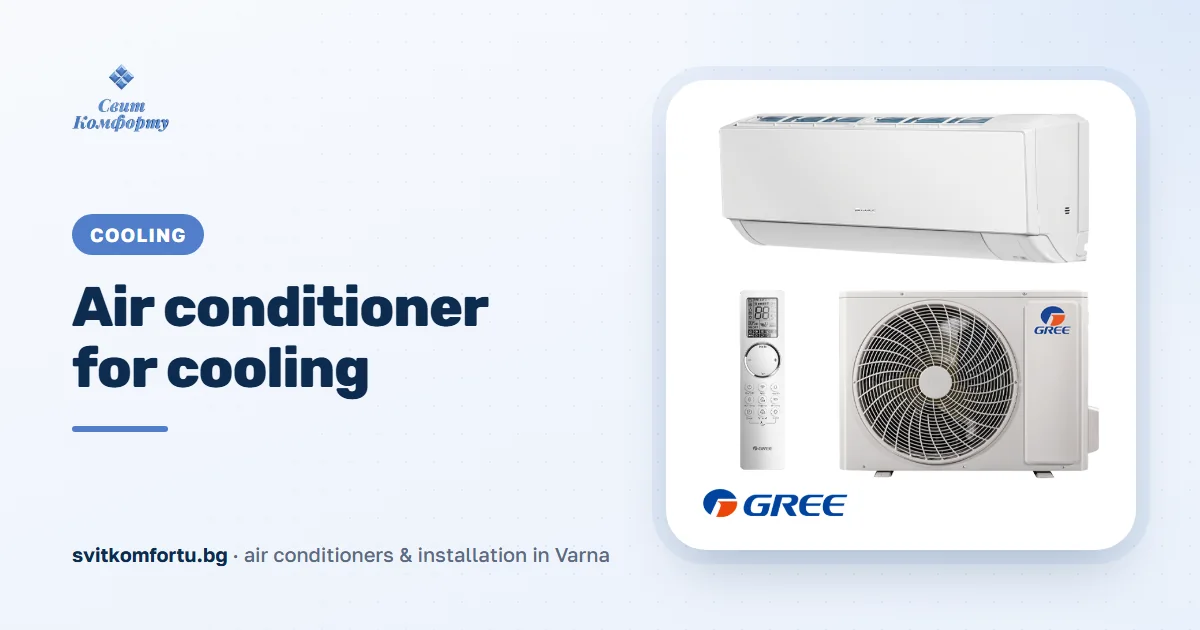
Air Conditioner for Cooling – How to Choose the Best Model for Your Home or Office
As the summer months arrive and outdoor temperatures rise, choosing the right air conditioner for cooling becomes a strategic decision for every home or office. Effective air conditioning isn’t just a matter of comfort – it directly affects air quality, productivity, sleep and even electricity costs.
If you’re looking for a reliable air conditioner for cooling at a great price, our online store offers a wide range of models by capacity, energy class and budget. You can also browse the dedicated category of inverter air conditioners for home and office, which deliver high efficiency and low power consumption.
When choosing, it’s important to consider not only the price but also factors such as capacity (BTU), energy class (A++, A+++), power consumption and the room’s floor area. For larger spaces, you can also look at solutions such as powerful 12000 and 18000 BTU inverter air conditioners, which ensure even cooling.
What Type of Air Conditioner for Cooling Should You Choose?
Choosing the right type of air conditioner for cooling is the first and one of the most important steps toward efficient, economical comfort during the summer months. Different technologies offer different levels of performance, power consumption and ease of use.
If you’re looking for professional advice and installation in the region, take a look at air conditioners in Varna with installation and service, where you’ll find complete solutions for home and office.
The best solution for primary cooling in a home is inverter wall-mounted air conditioners. They stand out with modern compressor control technology that smoothly adjusts output to the room’s needs.
Key advantages of an inverter air conditioner:
- Stable, even temperature without sharp fluctuations
- Low power consumption thanks to inverter technology
- Quiet operation, suitable for bedrooms and children’s rooms
- Long compressor service life
- Higher seasonal energy efficiency (SEER)
An inverter air conditioner for cooling is especially suited to daily use, when the unit runs for several hours a day. Thanks to its high energy class (A++ or A+++), it provides economical cooling and an optimal balance between price and quality.
When choosing a brand, it’s important to go with proven manufacturers. You can browse all established air conditioner brands, and if you’re interested in premium solutions, see the series of LG air conditioners with inverter technology, which combine high efficiency with modern design.
Portable air conditioners can be an option as a temporary solution – for example, in rented premises or where installation isn’t possible. They’re easier to set up but are usually noisier and less efficient than wall-mounted inverter models.
When you seriously need efficient, long-term cooling, a wall-mounted inverter model remains by far the better choice. It ensures better performance, lower electricity bills and greater comfort throughout the summer season.
What Capacity (BTU) Do You Need?
Choosing the right capacity (BTU) is crucial for effective cooling. If the air conditioner is underpowered, it will run continuously at maximum load, leading to higher power consumption, faster wear and uneven temperatures in the room. On the other hand, an oversized air conditioner may cool too quickly and cause discomfort.
To make the right choice, you need to take into account the floor area, insulation, orientation and number of people in the room.
Main capacities and uses
- 9000 BTU air conditioner – Suitable for rooms up to 18–20 m² (bedroom, children’s room)
- 12000 BTU air conditioner – Suitable for rooms of 20–30 m² (living room, kitchen)
- 18000 BTU air conditioner – Suitable for rooms of 30–40 m² (large living rooms, offices)
📊 Capacity Selection Table by Floor Area
| Capacity (BTU) | Suitable area | Room type | Recommendation |
|---|---|---|---|
| 9000 BTU | up to 20 m² | Bedroom, children’s room | Economical choice |
| 12000 BTU | 20–30 m² | Living room, kitchen | Most versatile choice |
| 18000 BTU | 30–40 m² | Large rooms | Higher load |
| 24000 BTU | 40–50+ m² | Open spaces | For large areas |
⚠ Important:
- Higher electricity bills
- Faster compressor wear
- Uneven cooling
- Shorter service life
Energy Class – Why Is It So Important?
When choosing an air conditioner for cooling, one of the most important indicators is its energy class. Models with class A++ or A+++ provide lower power consumption and higher seasonal efficiency (SEER), which directly affects your monthly electricity bills.
Advantages of a high energy class:
- Lower electricity consumption
- Lower monthly costs
- Higher seasonal efficiency
- Less load on the compressor
- Longer service life
The price difference between class A+ and A+++ often pays for itself within a few seasons, especially if the air conditioner is used heavily in summer.
Energy class comparison (sample consumption, kWh/year)
*Figures are approximate and depend on capacity, operating mode and room conditions.
📌 What does the chart show?
- An A+++ air conditioner can save up to 30–35% of electricity compared with A+
- At an average electricity price, that means noticeable annual savings
- Over 3–4 years of use, the higher class genuinely pays for itself
Inverter or Hyper-Inverter Air Conditioner?
When choosing an air conditioner for cooling , many buyers hesitate between a standard inverter and a hyper-inverter model. If you’re browsing inverter air conditioners, you’ll notice that most modern models offer high energy efficiency and optimal performance in both cooling and heating.
The truth is that for primary use in the summer season, you don’t always need to invest in a more expensive hyper-inverter, especially if the unit will be used mainly for cooling.
A standard inverter air conditioner is perfectly sufficient for summer use and offers an excellent balance between price, energy efficiency and performance. Thanks to inverter technology, the compressor adjusts its output smoothly, resulting in lower power consumption and a more stable indoor temperature.
Key advantages of an inverter air conditioner:
- Enough capacity for effective summer cooling
- Excellent energy efficiency (A++ / A+++)
- Stable, even temperature
- Lower electricity consumption during extended operation
- A more affordable price than hyper-inverter models
A hyper-inverter air conditioner is designed to work efficiently at very low outdoor temperatures – often down to -20°C or lower. It’s better suited for primary heating in winter, especially in regions with a colder climate. If you’re looking for premium solutions from proven manufacturers, you can browse the available air conditioner brands, where you’ll find both standard inverter and hyper-inverter models.
In cooling, the performance difference between an inverter and a hyper-inverter is minimal. If your goal is an economical air conditioner for coolingthat maintains a comfortable temperature through the summer months without unnecessary investment, a standard inverter model is perfectly sufficient.
📊 Comparison: Inverter vs. Hyper-Inverter Air Conditioner
| Feature | Inverter air conditioner | Hyper-inverter air conditioner |
|---|---|---|
| Summer cooling | Excellent efficiency | Excellent efficiency |
| Heating at -15°C | Good performance | Very high efficiency |
| Heating at -20°C and below | Limited efficiency | Designed for extreme conditions |
| Energy class | A++ / A+++ | A+++ (higher SEER/SCOP) |
| Power consumption when cooling | Low | Low (similar to an inverter) |
| Price | More affordable | Higher |
| Suitable for | Primary cooling and moderate heating | Year-round use and cold regions |
Features Worth Having
Modern air conditioners for cooling are no longer just appliances for lowering the temperature. They offer smart technologies that improve comfort, optimize power consumption and create a healthier indoor environment. When choosing a model, pay attention not only to capacity and energy class but also to the features you’ll actually use.
Modern inverter air conditioners offer:
- Wi-Fi control
- 3D airflow
- Smart temperature sensors
- Dry mode
- Plasma and antibacterial filters for air purification
Wi-Fi control
Wi-Fi control lets you switch the air conditioner on or off remotely via a mobile app. That means you can cool the room before you even get home. Besides convenience, this feature also helps you manage power consumption more efficiently, since you can monitor and optimize the unit’s operation.
3D airflow
Three-dimensional air distribution ensures even cooling throughout the room. Instead of cold air concentrating in one area, it’s distributed horizontally and vertically, eliminating “cold spots” and increasing comfort.
Smart sensors
Some models have sensors that detect presence in the room or measure the temperature at different points. This allows automatic output adjustment and contributes to lower power consumption.
Dry mode
When summer humidity is high, Dry mode helps reduce moisture in the air without lowering the temperature too much. This creates a more pleasant, healthier environment.
Purification filters
Plasma, ionizing and antibacterial filters improve air quality by capturing dust, allergens and fine particles. This is especially important for people with allergies or a sensitive respiratory system.
💡 Tip:
Not every extra feature makes an air conditioner better. Choose a model with features you’ll actually use to get the optimal balance between price, comfort and energy efficiency.
How Much Does an Air Conditioner for Cooling Cost?
The price of an air conditioner for cooling depends mainly on capacity (BTU), brand, energy class and additional features. A higher energy efficiency class, Wi-Fi control or a designer finish can increase the final price, but the investment often pays for itself through lower power consumption and a longer service life.
Approximate price ranges:
- 9000 BTU – from about €305–460
- 12000 BTU – from €360–615
- 18000 BTU – from €560–920
- Premium designer models – over €1 020
📊 Table of Approximate Prices by Capacity
| Capacity (BTU) | Suitable area | Price range | Suitable for |
|---|---|---|---|
| 9000 BTU | up to 20 m² | 305 – 460 € | Bedrooms, small rooms |
| 12000 BTU | 20 – 30 m² | 360 – 615 € | Living rooms, medium-sized rooms |
| 18000 BTU | 30 – 40 m² | 560 – 920 € | Large rooms, offices |
| 24000 BTU | 40+ m² | 820 – 1 280+ € | Open spaces |
| Premium series | Varies | 1 020+ € | Designer and high-end models |
📌 It’s important to note that the final price may vary depending on warranty terms and whether installation is included.
In the online store of Svitkomfortu.bg you can find air conditioners in different price categories – from budget solutions to high-end models with innovative technologies, suitable for every budget and room type.
Power consumption when cooling
One of the most frequently asked questions when choosing an air conditioner for cooling is how much electricity the unit will use and how that will affect the monthly electricity bill.
Inverter air conditioner 12000 BTU usually consumes between 0.8 – 1.2 kW under normal operation. Thanks to inverter technology, the compressor doesn’t run constantly at maximum output but adjusts its speed to the set temperature, which significantly reduces average consumption.
At an average of 6–8 hours of operation a day, the monthly cost remains entirely manageable, especially with a high energy class model (A++ or A+++).
📊 Sample Monthly Cooling Cost (12000 BTU)
| Average consumption | Hours per day | kWh per month | Approximate cost* |
|---|---|---|---|
| 0.8 kW | 6 hours | ~144 kWh | ~18–23 € |
| 1.0 kW | 8 hours | ~240 kWh | ~28–36 € |
| 1.2 kW | 8 hours | ~288 kWh | ~33–43 € |
*Calculated at an average electricity price of ~€0.13–0.15/kWh. Actual consumption depends on insulation, outdoor temperature and operating mode.
What Affects Power Consumption?
- Room area and height
- Orientation (south-facing rooms heat up more)
- Insulation and windows
- How often doors and windows are opened
- Set temperature (lower temperature = higher consumption)
💡 Tip:
Setting the air conditioner to 24–26°C instead of 20–21°C can reduce consumption by up to 15–20% without losing comfort.
How to Choose the Right Air Conditioner for Cooling?
Choosing a suitable air conditioner for cooling shouldn’t be based only on price or brand. To ensure efficient, economical cooling, it’s important to analyze the specific characteristics of the room. Correct sizing that matches real conditions will save you unnecessary electricity costs and extend the unit’s life.
Pay attention to the following factors:
📐 Floor area
The room’s floor area is the main criterion when choosing capacity (BTU). A small room up to 20 m² usually needs 9000 BTU, while a living room of 25–30 m² requires a 12000 BTU air conditioner. Underestimating the floor area leads to insufficient cooling and a constant load on the compressor.
🧱 Insulation
Good exterior and interior insulation significantly reduces heat gains. With poor insulation or old windows, you may need a more powerful air conditioner for cooling to compensate for the additional heating.
☀ Orientation
South- and west-facing rooms heat up more during the day. If the room gets direct sunlight, especially in the afternoon, this increases the heat load and requires higher capacity.
🪟 Large windows
Large glazed areas and panoramic windows let in more solar heat. In such cases, it’s advisable to consider a higher capacity or use blinds and UV-protective glass.
👥 Number of people in the room
Every person gives off heat. In an office or a room with more people, the air conditioner must account for the additional heat load. The same applies to appliances – computers, TVs, kitchen appliances and lighting.
💡 Practical tip:
If you’re torn between two capacities (for example, 9000 and 12000 BTU), it’s better to choose the slightly higher capacity, especially with a south-facing orientation or poor insulation. Inverter technology will adjust the output automatically and won’t lead to unnecessary power consumption.
Frequently Asked Questions
❓ What is the best air conditioner for cooling?
In most cases, the best choice is an inverter air conditioner with an A++ or A+++ energy class. These models provide high energy efficiency, lower power consumption and a stable room temperature. Inverter technology allows smooth output adjustment, which increases comfort and extends the unit’s service life.
❓ Is a 9000 BTU air conditioner enough for a living room?
9000 BTU air conditioner is enough only if the room is up to about 18–20 m² and well insulated. For a larger living room (25–30 m²), it’s advisable to choose 12000 BTUto ensure effective cooling without overloading the compressor. An incorrectly sized air conditioner may run constantly at maximum output, which increases power consumption.
❓ Is an expensive air conditioner better?
Not always. A higher price often means more features, a higher energy class or a designer finish, but the most important factor remains the right capacity for the room. Even a premium model won’t work efficiently if it’s incorrectly sized. The balance between price, BTU and real needs is the key to a good choice.
❓ How much electricity does an air conditioner use for cooling?
Inverter air conditioner 12000 BTU usually consumes between 0.8 and 1.2 kW under normal operation. Actual consumption depends on insulation, outdoor temperature and the set mode. Models with class A+++ can save up to 30% of electricity compared with lower classes.
❓ Is it better to run the air conditioner constantly or switch it off?
With inverter air conditioners, it’s more economical to maintain a stable temperature than to switch them on and off frequently. Continuous operation at low speed is more efficient than rapid cooling after a full shutdown.
Conclusion
Choosing the right air conditioner for cooling shouldn’t be random or based solely on price and brand. The key to long-term comfort is the right balance between capacity (BTU), energy efficiency, the room’s real characteristics and your available budget. A well-chosen air conditioner will not only provide fast, even cooling but also save you unnecessary electricity costs in the long run.
If you’re looking for a reliable, economical solution for the summer season, go with an inverter air conditioner with correct sizing and a high energy class A++ or A+++. That way you’ll get a stable temperature, lower electricity consumption and a longer service life for the unit.
Investing in a quality air conditioner for cooling is an investment in comfort, peace of mind and a healthy indoor environment. With the right choice, you’ll enjoy cool air all summer long, without worrying about high bills or inefficient operation.