
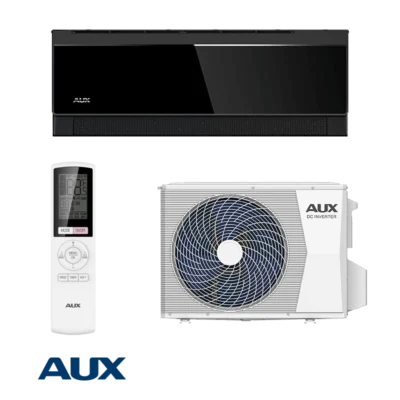
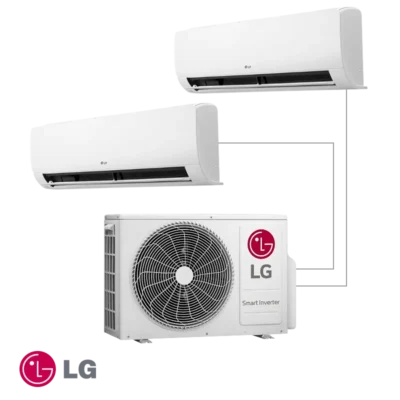
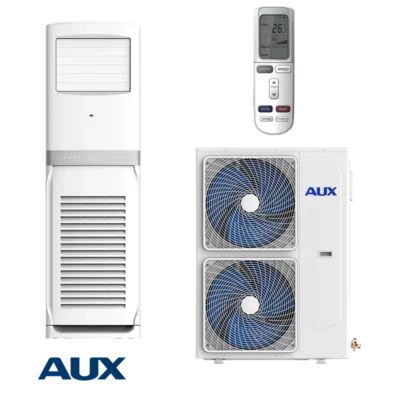


Short answer: for heating, a floor-standing air conditioner is more comfortable because it delivers warm air low down and the room warms up from the floor. A wall-mounted unit heats on the same principle, but from above, so its louvres need to point downwards. The floor unit costs more and takes up space at the bottom of the wall. The wall unit is cheaper and is enough when there is room high on the wall and the unit is set up correctly. Floor-standing models in stock range from 9,000 to 21,000 BTU, with prices from 760 €. The site survey is free in Varna and up to 200 km from it.
The question usually comes up in autumn, when an air conditioner is about to replace a stove or a radiator. Both types are split systems with an outdoor unit. The difference is the indoor unit: where it sits, where the air comes out and how much it costs.
How a wall-mounted and a floor-standing unit heat
Warm air is lighter and rises. A wall unit is mounted high under the ceiling and blows air from above. If the louvres are horizontal, the heat stays under the ceiling and it is cool down below. That is why in heating mode the airflow should point at the floor. How to do this is described in the article setting an air conditioner for heating.
A floor unit sits low, in place of a radiator or under the window. Warm air starts at the floor and rises through the room. Some models have two outlets, top and bottom. On the Daikin Perfera floor unit (FVXM) and Toshiba Bi-flow, in heating mode the air can also come out of the lower outlet, at foot level.
The type of indoor unit does not by itself make the air conditioner more economical. Consumption depends on the capacity, the model’s SCOP and how much heat the room loses. The difference is in how the warmth feels in the room.
Floor-standing or wall-mounted: comparison
| Floor-standing | Wall-mounted | |
|---|---|---|
| Position | low on the wall or on the floor, the size of a radiator | high on the wall |
| Heating | warm air starts from below | warm air starts from above, louvres point down |
| Cooling | works, but cold air stays lower | cold air falls from above through the room |
| Filters | you clean them without a ladder | a ladder is needed |
| Furniture | the space in front must stay clear | does not get in the way of furniture |
| Capacity in stock | 9,000 – 21,000 BTU | from 9,000 BTU, including more powerful models |
| Price in stock | from 760 € | lower for the same brand and capacity |
A floor indoor unit is about 60 cm high, 70 – 75 cm wide and 21 – 24 cm deep. These are the dimensions from the product cards of floor models in our catalogue (LG, Hitachi, Nippon, Daikin).
When to choose a floor-standing and when a wall-mounted unit
A floor-standing air conditioner makes sense when:
- the air conditioner is the main heating for the room and you want warmth at foot level;
- there is no room high up, as in an attic with a sloping ceiling or with windows up to the ceiling;
- you want the unit under the window or in place of an old radiator;
- you do not want an airflow from above towards where you sit.
A wall-mounted air conditioner is enough when:
- there is room high on the wall and the budget matters more;
- there is furniture along the bottom of the wall that you do not want to move;
- the room is over 50 m²: there are no floor models above 21,000 BTU in stock;
- the air conditioner is mainly for cooling in summer.
Pros and cons of a floor-standing air conditioner
Pros:
- the warmth starts from the floor instead of gathering under the ceiling;
- the filters come out without a ladder;
- the unit fits where the radiator used to be;
- there is no airflow from above in the room.
Cons:
- a higher price than a wall model of the same brand and capacity;
- it takes space at the bottom and there can be no furniture or long curtains in front of it;
- the choice is smaller: 25 floor models in stock against hundreds of wall models;
- capacity in stock goes up to 21,000 BTU.
Installing a floor-standing air conditioner: what is different
The outdoor unit is installed the same way as with a wall air conditioner. The differences are in the indoor unit:
- Position. The unit is fixed low on the wall or stands on the floor. Free space must be left in front of it so the air can come out.
- Pipes. The pipes and cable leave from the back or the side and go through the wall to the outdoor unit. The closer the unit is to the outside wall, the shorter the pipe run.
- Drainage. Water from the unit drains with a downward slope. Since the unit sits low, the drain outlet outside is checked during the survey.
- Power supply. The air conditioner needs its own line from the board, as with a wall model.
Standard installation of a wall air conditioner up to 14,000 BTU is 150 €, and from 16,000 to 24,000 BTU it is 180 €. What this price includes is described in the article standard air conditioner installation. A floor-standing air conditioner is installed at the same prices: 150 € up to 14,000 BTU and 180 € from 16,000 to 24,000 BTU. How the installation works is on the page air conditioner installation in Varna. Our technicians are certified, we also work at weekends, and the installation warranty is 1 year.
What capacity of floor-standing air conditioner you need
Capacity is chosen by floor area, as with a wall unit:
| Area | Capacity |
|---|---|
| 15 – 25 m² | 9,000 BTU |
| 25 – 35 m² | 12,000 BTU |
| 35 – 50 m² | 18,000 BTU |
| 50 – 70 m² | 24,000 BTU |
If the air conditioner will be the main heating, take the next size up. Floor models in stock go up to 21,000 BTU, so for 50 – 70 m² choose a 24,000 BTU wall unit or two floor units in different parts of the room. The details are in the article how many BTU I need. Models with a high SCOP that work at low temperatures are in the ranking of air conditioners for heating.
Prices of floor-standing air conditioners in stock
There are 25 floor models from 9 brands in stock. Here is where prices start for some series:
- Gree, GEH floor type: from 1 014 €;
- Toshiba Bi-flow: from 1 396 €;
- Daikin Perfera, FVXM floor unit: from 1 777 €;
- Mitsubishi Electric MFZ-KT: from 2 484 €.
The price difference is easy to see within one series. Mitsubishi Heavy Industries ZS at 9,000 BTU costs from 939 € as a wall unit (SRK25ZS-W) and from 1 395 € as a floor unit (SRF25ZS-W).
All models with prices and availability are on the page floor-standing air conditioners. Wall models are in the category inverter air conditioners. For heating with an air conditioner in general, read air conditioner for heating. We do surveys in Varna and up to 200 km from it: Dobrich, Shumen, Burgas and the coastal resorts. You get a written quote within 24 hours of the survey.
Frequently asked questions
Which air conditioner is better for heating, floor-standing or wall-mounted?
For heating, the floor unit is more comfortable because it delivers warm air low down and the room warms up from the floor. The wall unit also heats well if the louvres point down. Power consumption depends on the capacity and SCOP of the model. The type of indoor unit does not change it.
How much more does a floor-standing air conditioner cost?
Within the same series and capacity, the floor unit costs more. For example, Mitsubishi Heavy Industries ZS at 9,000 BTU is from 939 € as a wall unit and from 1 395 € as a floor unit.
Can a floor-standing air conditioner go where the radiator was?
Yes. A floor unit is about 60 cm high and usually goes under the window or where the radiator used to be. The position, pipe run and drainage are agreed at the survey.
Is there a floor-standing air conditioner without an outdoor unit?
Such units are made, but the compressor is inside the room. The floor models in our catalogue are split systems: an indoor unit in the room and an outdoor unit outside.
What capacity of floor-standing air conditioner do I need?
The same as for a wall unit: 9,000 BTU for 15 – 25 m², 12,000 BTU for 25 – 35 m², 18,000 BTU for 35 – 50 m². If the air conditioner is the main heating, take the next size up.
How much does installing a floor-standing air conditioner cost?
The same as for a wall unit: 150 € up to 14,000 BTU and 180 € from 16,000 to 24,000 BTU. The survey is free in Varna and up to 200 km from it.