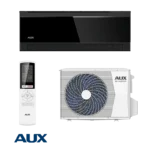
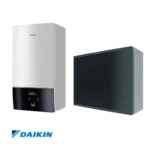
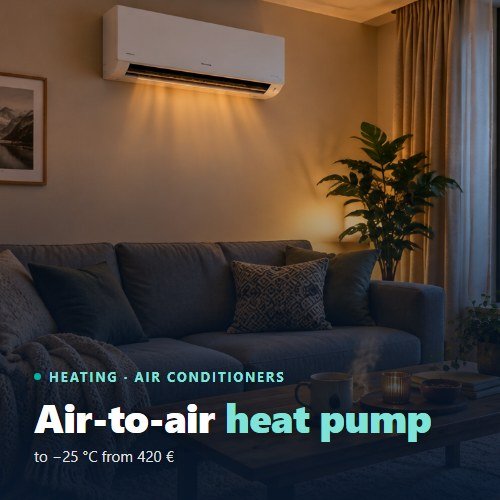
Short answer: an air-to-air heat pump is an inverter air conditioner that heats. It takes heat from the outdoor air and delivers it straight into the room, with no water and no radiators. A good model gives 4–5 kWh of heat for every 1 kWh of electricity. Our catalogue starts at 300 €, and models that heat down to −25 °C start at 420 €.
Air conditioner or heat pump: the same device
Every inverter air conditioner with a heating mode is a heat pump. The compressor moves heat from a colder place to a warmer one, just as a fridge moves heat from its inside to the room. In winter the air conditioner reverses the cycle and brings heat from the street into the room.
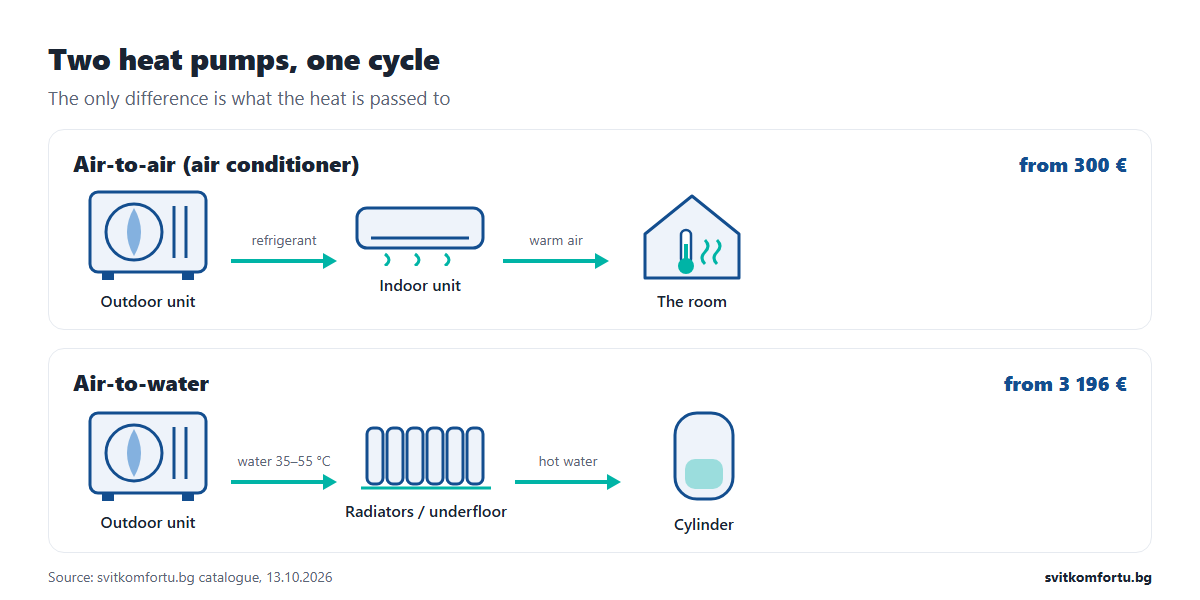
That is why manufacturers list split systems as “air-to-air heat pumps”. In everyday language the difference between an “air conditioner” and a “heat pump” is only what the unit is connected to:
| Air-to-air (air conditioner) | Air-to-water | |
|---|---|---|
| What it heats | the air in the room | water in radiators or underfloor heating |
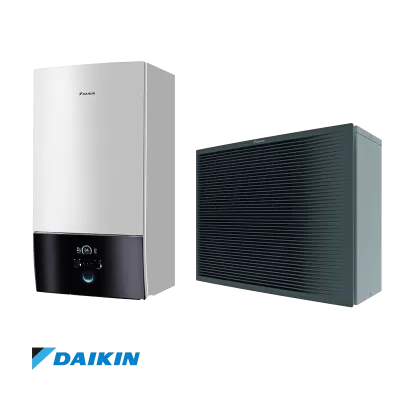
| Hot water for the bathroom | no | yes, with a cylinder |
| Summer cooling | yes, fully | limited (underfloor, fan coils) |
| Entry price in our catalogue | 300 € | 3 196 € |
| Installation | about a day, no renovation | hydraulic connection, often a new heating system |
| Best for | apartments, single rooms, offices | a whole house with a water heating system |
How the other type works is explained in how an air-to-water heat pump works. Here we cover only air conditioners that heat.
Three numbers that decide whether it keeps you warm in January
The label shows many parameters. For winter, three matter.
1. The lower limit of the operating range
It is written as “Heating temp.: −25 ~ 24 °C”. The first number is the lowest outdoor temperature at which the unit still heats. Below it the compressor stops and the room cools down.
In Varna and on the Black Sea coast winter temperatures rarely drop below −10 °C, so a −15 °C limit is enough for most homes. For Dobrich, Shumen and inland areas, where cold spells go deeper, look for −20 °C or lower.
2. Maximum heating capacity
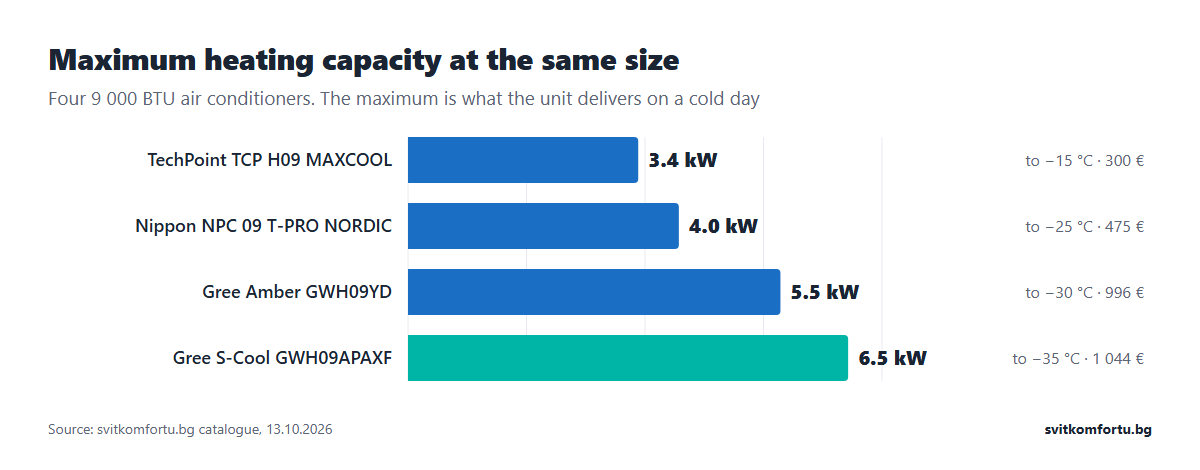
The product page lists it as three numbers: minimum / rated / maximum in kW. The rated value is for mild weather. The maximum is what the unit can deliver on a cold day, and units of the same size differ a lot here:
| Model, 9 000 BTU | Max. heating | Works down to | Price |
|---|---|---|---|
| TechPoint TCP H09 MAXCOOL | 3.4 kW | −15 °C | 300 € |
| Nippon NPC 09 T-PRO NORDIC | 4.0 kW | −25 °C | 475 € |
| Gree Amber GWH09YD | 5.5 kW | −30 °C | 996 € |
| Gree S-Cool GWH09APAXF | 6.5 kW | −35 °C | 1 044 € |
All four are 9 000 BTU units. Yet at full output the last one gives almost twice as much heat as the first. If the air conditioner will be your main heating rather than a top-up, you feel this difference on the coldest days.
3. SCOP and the heating class
SCOP is the seasonal coefficient: how many kWh of heat you get on average over the season for 1 kWh of electricity. The heating class is the second mark in “A+++ / A++” (the first is for cooling). As a guide:
- A+ — SCOP 4.0–4.6;
- A++ — SCOP 4.6–5.1;
- A+++ — SCOP 5.1 and above.
If the SCOP and the class on a product page do not match, trust the class, because it comes from the energy label. What this difference costs in electricity, by BTU size, is worked out in how much electricity an air conditioner uses.
“Works down to −25 °C” is not a premium feature
We counted all 395 inverter air conditioners in stock with a listed price and grouped them by their lower heating limit:
| Heats down to | Models | 9 000 BTU, from | 9 000 BTU, median |
|---|---|---|---|
| −15 °C | 225 | 300 € | 955 € |
| −16 … −21 °C | 97 | 325 € | 1 615 € |
| −22 … −25 °C | 54 | 420 € | 714 € |
| −30 °C and below | 7 | 996 € | 1 020 € |
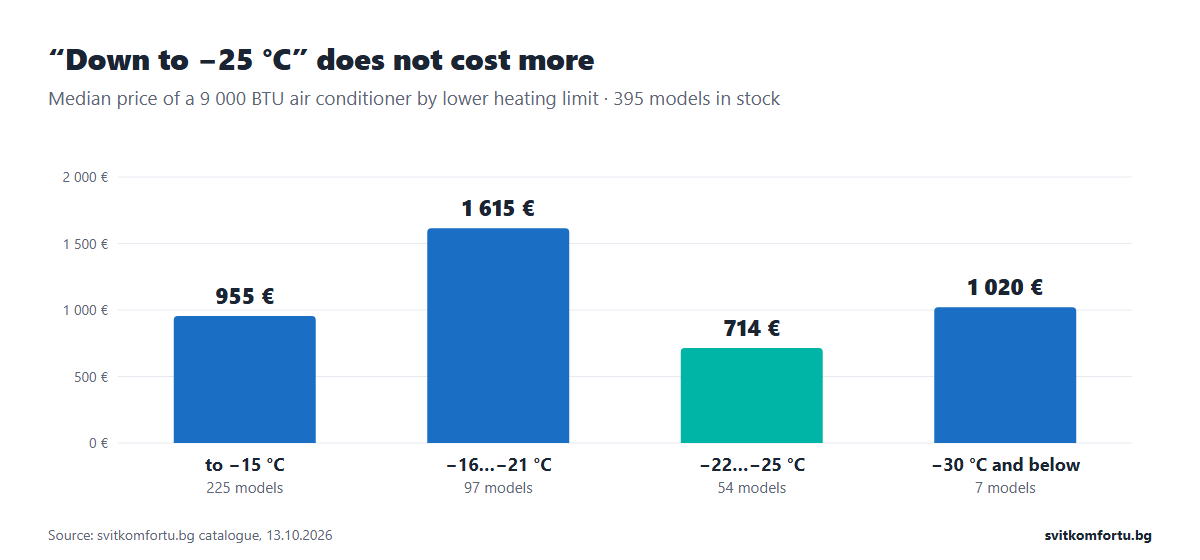
The typical air conditioner that heats down to −25 °C is cheaper than the typical one with a −15 °C limit. The reason is that budget brands also make “Nordic” series, while expensive Japanese models often keep a standard −15 °C or −20 °C limit. You pay for quietness, filtration, design and brand, not for cold resistance.
So if someone offers you a “Nordic” model at a premium, ask about maximum capacity and the heating class. Pick the lower limit for your climate. It is rarely what drives the price.
What makes an air conditioner “Nordic”
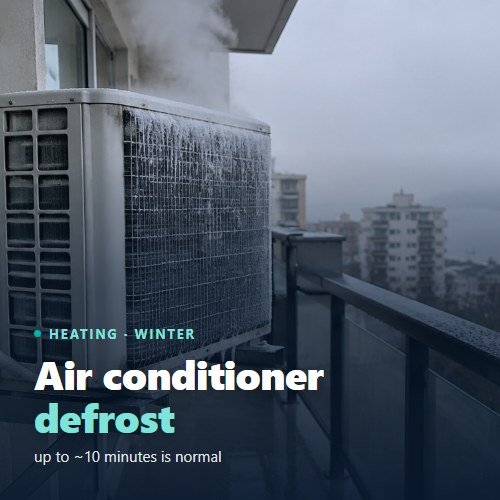
Nordic series (Nordic, Arctic, models with a limit below −25 °C) differ in hardware, not software. First, they have a heated drain pan. When the outdoor unit defrosts, water runs off it. In frost that water freezes in the pan, and after a few cycles the ice blocks the fan. The heater prevents that.
Second, the compressor has a heater: oil thickens in the cold, and starting without it wears the machine. Third, the heat exchanger is larger and the compressor works over a wider range. That is why maximum capacity does not collapse when it is cold outside.
If you will heat only with an air conditioner, rather than just topping up central heating, these three things matter more than Wi-Fi or an ioniser.
When air-to-air is the better choice than air-to-water
- An apartment or a small house up to about 80 m². Two or three air conditioners cover the living areas for a fraction of the cost of a water system. We look at the options separately in heat pump for an apartment.
- You have no water heating system. Installing radiators or underfloor heating often costs more than the air-to-water heat pump itself.
- You also want cooling. An air conditioner cools fully. An air-to-water system cools only with underfloor heating or fan coils.
- You are replacing convectors or oil radiators. They have a coefficient of 1.0, an air conditioner 4–5. The bill for the same heat falls several times, see the comparison in cheap electric heating.
Air-to-water wins when you heat a whole house, already have radiators or underfloor heating and want hot water from the same system. The calculation with prices and installation for a 100–150 m² house is in the article heat pump or air conditioner for a house. Prices by floor area are in heat pump for a house — price.
How to choose in 2 minutes
- Size. Work out BTU by area and insulation with the how many BTU do I need calculator. If the unit will be your main heating, go one size up.
- Lower limit. Varna and the coast: −15 °C is enough. Inland: −20 °C or lower.
- Maximum heating capacity. At the same BTU, pick the higher maximum.
- Heating class. A++ or higher if you heat every day.
A ready list built on these criteria is in our ranking of the best air conditioners for heating. All models in stock are in air conditioners for heating. We install in Varna and along the Black Sea coast and will help you choose the size on site.
Frequently asked questions
What is an air-to-air heat pump?
It is an inverter air conditioner that, in heating mode, moves heat from the outdoor air to the air in the room. Every split system with heating is an air-to-air heat pump.
What is the difference between a heat pump and an air conditioner?
Technically, the cycle is the same. An air-to-water heat pump heats water for radiators, underfloor heating and the bathroom. An air conditioner, that is an air-to-air heat pump, heats the air directly and does not make hot water.
Down to what temperature does an air conditioner heat?
It depends on the model. Standard units heat down to −15 °C, Nordic series down to −25 °C, and some down to −30 and −35 °C. The limit is shown on the product page as “Heating temp.”.
Can a whole apartment be heated with air conditioners only?
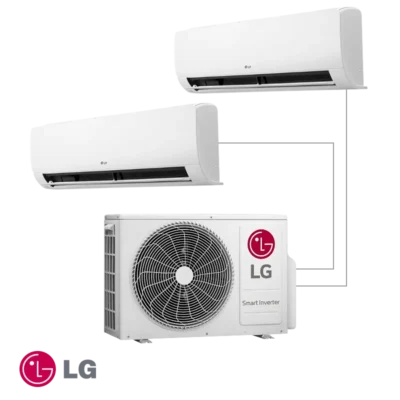
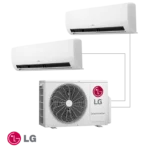
Yes, if every living room has an indoor unit or air circulates freely between rooms. For several rooms on one outdoor unit there are multi-split systems.
Can an air conditioner be converted into an air-to-water heat pump?
We do not recommend it. Such a conversion changes the refrigerant circuit, voids the warranty and requires a certified technician to handle refrigerant. A ready air-to-water heat pump in our catalogue starts at 3 196 € and comes with a warranty.
How much electricity does an air conditioner use in winter?
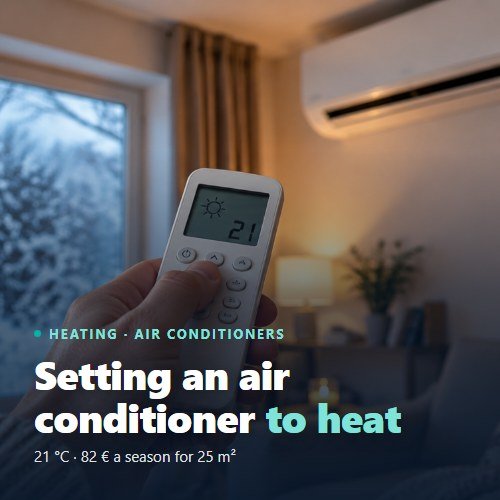
For a 25 m² room in Varna needing 2 500 kWh of heat per season, an air conditioner uses about 550 kWh of electricity, or about 82 € at 0.15 €/kWh. The same heat from a convector costs about 375 €.
Do more expensive air conditioners heat better in the cold?
Not necessarily. In our catalogue the median price of models that heat down to −25 °C is 714 € for 9 000 BTU. The median for models with a −15 °C limit is 955 €. For cold weather, look at the lower limit and maximum capacity, not the price.