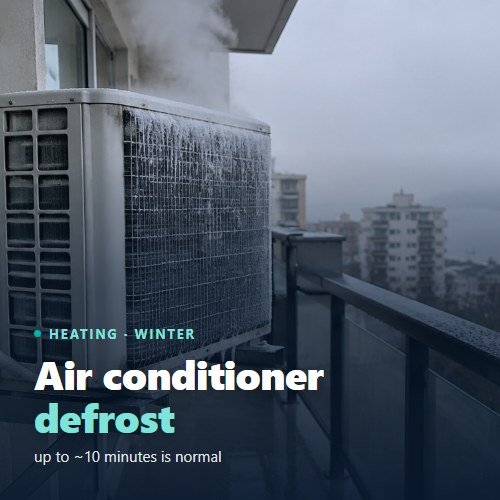
Short answer: defrosting is a normal part of heating. When it is around freezing outside and the air is humid, frost builds up on the outdoor unit. The air conditioner stops blowing warm air for a few minutes, usually up to 10, reverses the cycle and melts the ice. Steam comes out of the outdoor unit and water drains away, and the light on the indoor unit often blinks. After that, heating resumes on its own. It is a fault when the ice does not melt, grows with every cycle or the air conditioner stops every 10–15 minutes.
Below is what exactly happens during defrosting, why the Varna winter falls right into the frosting zone, how to tell normal operation from a fault and what you can do yourself. How to choose a model that heats reliably in frost is covered in air conditioners for heating.
What happens when an air conditioner defrosts
In heating mode the outdoor unit works like a refrigerator: its heat exchanger is colder than the air so it can take heat from it. When its surface drops below 0 °C, moisture from the air freezes on the fins. The frost blocks the airflow and the air conditioner heats less and less.
The electronics monitor the heat exchanger temperature and at some point start defrosting:
- the indoor unit fan stops so it does not blow cold air at you;
- the four-way valve reverses the refrigerant flow and the hot gas goes to the outdoor unit;
- the outdoor unit fan stops and the ice melts from the inside out;
- steam comes out of the unit and water drains, sometimes you hear hissing or the valve clicking;
- the cycle returns to heating and after a short warm-up the indoor unit blows warm air again.

Signs that defrosting is normal
- The indoor unit stops blowing for a few minutes and then resumes on its own.
- The operation or heating light blinks during the pause (on many models).
- White steam comes out of the outdoor unit. This is water vapour from the melting ice, not smoke.
- There is water or a thin layer of ice under the outdoor unit.
- You hear a short hiss at the switchover.
- Heating comes back and the frost disappears completely after the cycle.
If this is exactly what you see, do nothing. Do not switch the air conditioner off during defrosting: you interrupt the cycle and the ice stays.
Why air conditioners in Varna defrost often
Frost forms most easily when it is around −5…+5 °C outside and the air is humid. In severe cold the air is drier and frost builds up more slowly. The Varna winter falls right into the zone where moisture freezes most easily: average monthly temperatures from December to February are between 2 and 5 °C, and humidity from the sea is high.
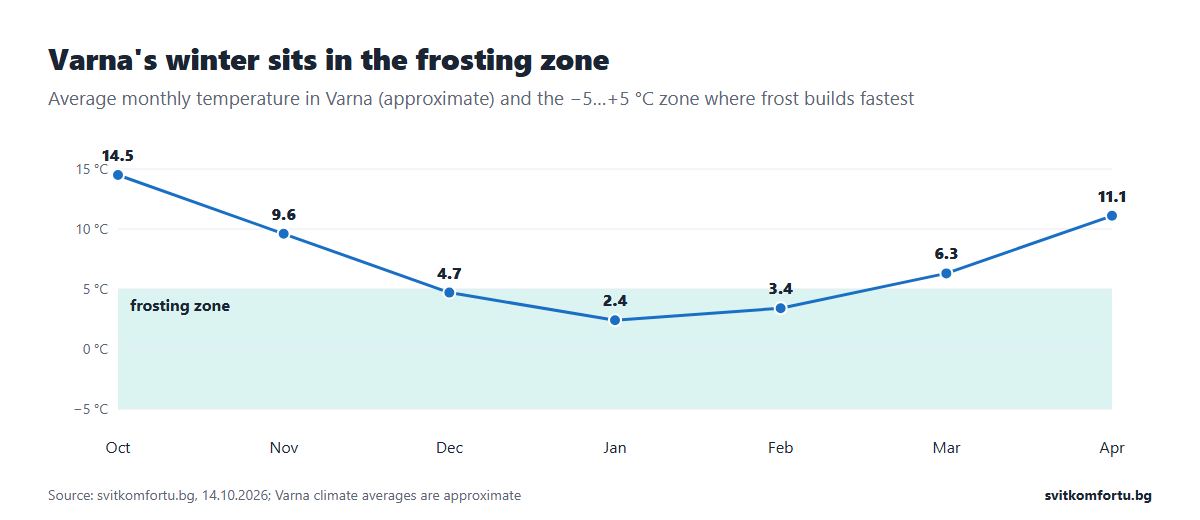
That is why on foggy January mornings it is common for the air conditioner to defrost more often than on a clear day at −8 °C. This is not a sign of a weak unit. A sign of a weak unit is when the room does not warm up after defrosting.
How often is normal
There is no single figure for all models. The interval depends on temperature, humidity, capacity and electronics. As a guideline:
| Outdoor conditions | What is usual | What is worrying |
|---|---|---|
| Above +7 °C, dry | rarely or never defrosts | frost on the unit |
| Around 0…+5 °C, fog, rain, wet snow | a cycle every 30–60 minutes | a cycle every 10–15 minutes |
| Below −5 °C, dry | less frequent cycles | the ice does not disappear after a cycle |
| Below the model’s lower limit | the air conditioner stops heating | this is normal for the model, but it is no longer enough for heating |
The defrost itself usually lasts a few minutes, up to about 10. If the indoor unit stays silent for longer, see the next section.
Defrosting and the electricity bill
During the cycle the air conditioner uses electricity but gives no heat to the room. So frequent defrosting really does raise the bill. There are, however, two points to add.
First, defrost losses are already included in the declared SCOP. Seasonal efficiency is tested under a European standard at several temperature points, including around +2 °C, where the outdoor unit frosts up. That is why the calculations in our articles on cheap electric heating and how much electricity an air conditioner uses also apply to a humid Varna winter.
Second, the extra costs come from dirt, not from the weather. Dust on the fins of the outdoor unit and clogged filters make the air conditioner frost up faster and defrost more often. This is a cost that cleaning removes.
When defrosting is a sign of a fault
| Symptom | Likely cause | What to do |
|---|---|---|
| The ice does not melt and grows with every cycle | a faulty sensor, a valve problem or an electronics problem | switch off and call a technician |
| Defrosts every 10–15 minutes | dirty heat exchanger, low refrigerant, weak airflow | clean the filters, then book servicing |
| Ice on the pipes or on the indoor unit | low refrigerant or blocked airflow inside | a technician, do not top up yourself |
| Ice at the bottom of the outdoor unit, the fan rattles or does not turn | defrost water frozen in the drain pan | let it melt and call a technician; Nordic series have a drain pan heater |
| Does not heat after defrosting | a cycle error or below the model’s lower limit | check the outdoor temperature and the error code |
| Error code on the display | depends on the brand | write down the code, restart by cutting the power, call a technician if it repeats |
The most common cause of too frequent defrosting is trivial: dust on the filters and on the fins of the outdoor unit. Air passes with more difficulty, the heat exchanger gets colder and frost builds up faster. Servicing a standard wall-mounted air conditioner in Varna costs 42 € with us, see air conditioner servicing. With an error code or ice that does not melt you need air conditioner repair.
What you can do yourself
- Clean the filters of the indoor unit. This is the easiest step with the biggest effect. How to do it is described in our article on seasonal air conditioner preparation.
- Clear snow and leaves around the outdoor unit if you can reach it safely. Leave at least 30 cm of free space at the sides and the back.
- Do not pour hot water on the unit and do not knock the ice off. The fins bend easily, and a sharp temperature difference does harm.
- Make sure water can drain. Defrost water needs somewhere to run off. If the unit is on a balcony, the water must not freeze on a footpath or on the neighbours below.
- A snow canopy above the unit helps, but do not cover it completely. The outdoor unit needs air in heating mode too.
- Do not switch off the air conditioner while it is defrosting. Wait for the cycle to finish.
How to choose an air conditioner that copes better
All air conditioners that heat also defrost. The difference is in how well they deal with the water and how much heat they give between cycles. When choosing, look at:
- The lower heating limit. Of the 394 inverter models in stock in our catalogue, 225 heat down to −15 °C and 60 down to −25 °C or lower. For Varna −15 °C is usually enough, but if the air conditioner is your main heating, a margin helps.
- A drain pan heater. Nordic series have one, and defrost water does not freeze at the bottom of the unit. More about them in our article on the air-to-air heat pump.
- Capacity with a margin. A unit that runs at maximum all the time cools the outdoor heat exchanger more. The size is chosen by floor area: a 9 000 BTU unit for 15–25 m², a 12 000 BTU unit for 25–35 m², an 18 000 BTU unit for 35–50 m².
| Model | BTU | Heats down to | SCOP | Price |
|---|---|---|---|---|
| AUX J-Smart ASW-H09B5C4 | 9 000 | −25 °C | 4.0 | 460 € |
| Nippon NPC 09 T-PRO NORDIC | 9 000 | −25 °C | 4.6 | 475 € |
| Nippon NPC 12 T-PRO NORDIC | 12 000 | −25 °C | 4.7 | 525 € |
| Gree Airy GWH12AVCXD | 12 000 | −25 °C | 4.6 | 768 € |
| Gree Amber GWH09YD | 9 000 | −30 °C | 5.1 | 996 € |
Prices as of 14.10.2026. Whether a specific model has a drain pan heater, check in the technical data or ask us before you buy. All models by capacity are on the 9 000 BTU air conditioners and 12 000 BTU air conditioners pages.
The position of the outdoor unit matters too. A unit raised on brackets and with a water drain does not stand in a puddle and does not freeze from below. This is decided during air conditioner installation.
Air-to-water heat pumps defrost too
An air-to-water heat pump has the same outdoor unit and the same cycle. During defrosting it takes a little heat from the water in the system, so with underfloor heating or a buffer tank the pause is barely noticeable. How the whole system works is explained in our article on how an air-to-water heat pump works.
What to do now
If the air conditioner stops for a few minutes, lets out steam and then heats, everything is fine. If it defrosts every 10–15 minutes, clean the filters and book servicing. If the ice grows or an error code is showing, switch the air conditioner off and call us. The right heating setup is described in our article on setting an air conditioner to heat.
Frequently asked questions
Is it normal for an air conditioner to stop heating in winter?
Yes, if it stops for a few minutes and then resumes. This is the outdoor unit defrosting. It is not normal if it stops every 10–15 minutes or does not return to heating at all.
How long does air conditioner defrosting last?
Usually a few minutes, up to about 10. After that the indoor unit warms up and blows warm air again.
Why does steam come out of the outdoor unit?
It is water vapour from the frost melting during defrosting. It is not smoke and not a sign of a fault.
What is air conditioner defrost?
Defrost is the English name for defrosting. The air conditioner briefly reverses the cycle and melts the ice on the outdoor unit.
Can I remove the ice from the outdoor unit myself?
You can clear the snow around the unit if it is safe. Do not pour hot water and do not knock the ice off, because the fins bend. If the ice stays after a cycle, call a technician.
Why does the air conditioner blink and not blow?
On many models a blinking light in heating mode means warm-up or defrosting. Wait up to 10 minutes. If the display shows a code with letters and numbers, it is an error.
Which air conditioner defrosts less?
All of them defrost in humid weather around 0 °C. Nordic series with a drain pan heater and models that heat down to −25 °C cope better with water and cold.